Leaving the New Age for the Truth

Recently, a post popped up in my Facebook feed entitled “Why Some Women Leave the Church for the New Age.”

I thought it was interesting, because my journey went completely in the opposite direction.  I was raised with occult practices in my home and turned away from that as an adult when I found Jesus.

The next morning in church, when I pulled a notebook out of my Bible cover, I accidentally opened up to the wrong page.  In an entry from all the way back in 2016, it said, “Write something about the occult and the wiles of the devil.”  It was an idea for a blog post that I never followed through on.  I knew then that the Holy Spirit was reminding me to finally do it.

When I was growing up, my mother was into astrology.  At one point, my mom’s friend, Tony, taught her how to read tarot cards, and she in turn, taught my sister and I to do it.  

When we got into the tarot cards, we quickly began to get obsessed with it.  We didn’t want to make any major life decisions without consulting the cards.  One of the reasons that happened is because, believe it or not, sometimes the cards were right.  My mother once read for a woman and told her that there was a lump in her right breast.  The woman went to the doctor, and it turned out to be true, and she got treatment for it.  In moments like that, it appeared that the cards were a source of truth and light, and it encouraged us to put more faith in them.

The turning point happened one day when I was home alone.  I heard my sister’s voice calling my name, but no one was there.  When my sister and mother returned home, I told them about it, and surprised, they recounted having recently had the same experience.  My sister had heard my mother calling her, and my mother had heard my voice.  We also began to notice dark “shadows” darting by in our home.  We came to the realization that when reading the cards, we were actually inviting spirits into our home to communicate with us through them.  We were so freaked out that we stopped doing it for a while.

Prior to this, I’d been working one Saturday in Tony’s vitamin shop and there was a snowstorm that day, so we had no customers.  He read my cards for me to pass the time and wrote all of the predictions down on a slip of paper.  One of the things he predicted came true shortly after, so I apparently put the slip of paper in my journal to save it.

Twelve years later, a lot had changed in my life.  I’d given my life to Jesus, broken up with the man I’d been dating for eleven years when I found out that he never intended to marry me, and was praying for God to bring someone into my life who would feel the same way about me that I felt about him.  I became friends with a nice guy who I had a crush on, but I was not sure how he felt about me.  I was trying to heal from the past and to understand where I’d gone wrong and what I should be doing differently, so I pulled out my old journals, and that slip of paper fell out.  I’d completely forgotten about it.

Reading it, I discovered that among all of the predictions that Tony had made, he had focused on one particular thing, because throughout the reading, it kept coming up and interrupting whatever else we were talking about.  It was a night trip that I was going to take, under the stars, with a man who had an unusual name.  He wasn’t sure what the nature of the relationship was, but something about this night was very important.

I suddenly remembered that snowy day in the vitamin store and him asking me if I knew any men with that name.  At the time, I felt impatient because it was a name I’d never heard used for a man before and because I wanted him to bring up the name of someone else – the one I ended up wasting eleven years on.  But…reading this years later, I was stunned to realize that it was the name of the guy I currently had a crush on.  How could Tony have guessed that?  Was it some kind of sign from God?

I’d become a Christian maybe a year before this, so I was still a “baby Christian.”  I was still learning to surrender some areas of my life.  I went to a service at a Messianic church once, and the rabbi said, “If you feel that you need something besides God to be happy, you are making an idol of that thing and you need to repent.”  I think idolatry is probably a lifelong battle, but I had two battles in particular that I fought in those early days – idolizing love/marriage and a reliance on the occult.  I saw it as harmless, and something that could reveal things to me that I wanted to know but couldn’t see on my own.  If I could get this insight, maybe I wouldn’t make the kind of mistakes I’d made in the past, and I could avoid getting hurt again.

I didn’t do tarot anymore and I wouldn’t have gotten into anything deeper than that.  I’d had a friend from work several years before whose wife was involved with Wicca.  Mark and I initially bonded because of our shared interest in spirituality.  He came into the area where I worked to make a copy, and the machine kept jamming.  He asked for my help, and I saw that he wasn’t doing anything wrong, so I put the document in the machine myself and inconspicuously placed my palm on the machine and held it there while it made the copy.  When the copy came out fine, Mark said to me, “I saw what you did there.  You were trying to override my energy with yours.”  He was exactly right.  I’d noticed that there were certain employees that couldn’t make a copy or send a fax without the machine jamming, and it always worked for me, unless there was a mechanical issue.  We started chatting, and we were buddies from that point on.  When his wife got into Wicca, we thought it was cool at first.  She made him a good luck charm – a little pouch with some herbs and a tiger stone that he wore around his neck.  After I admired it, he had her make one for me, too.  However, a couple of years later, when we no longer worked together, he started sending me concerning messages.  His wife had joined a coven, and her new friends would come to the house and perform abusive acts on him.  I begged him to leave and later discovered that they had divorced, but we lost touch.

I had seen the spiritual darkness that some of these practices could lead to, but I still viewed astrology as a harmless tool, and I was willing to believe that God could speak to me through that tarot card reading from years before, even though I wasn’t actively into tarot anymore.  I believed it because it was telling me something that I wanted to hear at the time.   

2 Timothy 4:3-4 (NKJV) “For the time will come when they will not endure sound doctrine, but according to their own desires, because they have itching ears, they will heap up for themselves teachers; and they will turn their ears away from the truth, and be turned aside to fables.”

There are some branches of Christianity that try to blend the occult with biblical teaching – like Bethel.  However, the Bible makes it clear where God stands on the matter.

Leviticus 19:31 (NKJV) “‘Give no regard to mediums and familiar spirits; do not seek after them, to be defiled by them: I am the Lord your God.”

Deuteronomy 18:10 (NKJV) “There shall not be found among you anyone who makes his son or his daughter pass through the fire, or one who practices witchcraft, or a soothsayer, or one who interprets omens, or a sorcerer.”

Isaiah 8:19 (NKJV) “And when they say to you, “Seek those who are mediums and wizards, who whisper and mutter,” should not a people seek their God? Should they seek the dead on behalf of the living?”

Micah 5:12 (NKJV) “I will cut off sorceries from your hand, And you shall have no soothsayers.”

1 Timothy 4:1 (NKJV) “Now the Spirit expressly says that in latter times some will depart from the faith, giving heed to deceiving spirits and doctrines of demons.”

So, over time, as I was growing in my faith, I had to confront the fact that I couldn’t participate in things that God forbid and I needed to repent of it.  Just like a toddler doesn’t understand why when you tell them not to touch a hot stove, we often don’t understand why God is telling us not to do things, but it is for our own protection.  

It took time for me to come to that realization, though, and in the meantime, I held onto the hope that God had a plan for me with this guy, even though the relationship never moved forward.  I wasted a lot of time and energy – again – on hoping for something that was never meant to be.  It caused me a lot of discouragement, and that eventually led to some backsliding.  At some point, I realized that message written on that paper never was from God.  It was from the devil, who wanted to deceive me by using the things I idolized to pull me away from God.  He mixed some truth in with the lies (predictions of events that DID come true) to suck me in. 

Ephesians 6:10–12 (NKJV) “Finally, my brethren, be strong in the Lord and in the power of His might. Put on the whole armor of God, that you may be able to stand against the wiles of the devil. For we do not wrestle against flesh and blood, but against principalities, against powers, against the rulers of the darkness of this age, against spiritual hosts of wickedness in the heavenly places.”

When we rely on our own wisdom or our own strength, we aren’t relying on God.  In the Garden of Eden, the serpent asked Eve:

“Has God indeed said, ‘You shall not eat of every tree of the garden’?”

And the woman said to the serpent, “We may eat the fruit of the trees of the garden; but of the fruit of the tree which is in the midst of the garden, God has said, ‘You shall not eat it, nor shall you touch it, lest you die.’ ”

Then the serpent said to the woman, “You will not surely die. For God knows that in the day you eat of it your eyes will be opened, and you will be like God, knowing good and evil.” – Genesis 3:3-5

Satan rebelled out of pride, because he wanted to be equal with God.  He convinced Eve to rebel by promising her the same thing.  It’s a futile quest, though.  We will never be equal to the Creator of the universe, but we can and should rely on Him, which requires trust.  Trusting God is hard, though, especially when our experiences with trusting people have led to so much hurt.  We can fall into the trap of projecting those human frailties and failings onto God.  We think we will only ever be able to rely on ourselves and whatever strength that we have, since relying on others has led to disappointment in the past.

If you have fallen into this trap yourself, I beg you to ask yourself why. Is there some church hurt or disappointment in your life that you are subconsciously blaming God for?

I previously wrote another blog post about Renouncing God and blaming Him for the actions of sinful humans who claim to represent Him.  Churches are full of sinners, just like you and me.  If they weren’t, they would have no purpose.  Who needs a Savior if they are without sin?  However, so is your neighborhood, your workplace, your friend groups, etc.  You won’t escape sinners by fleeing church.  They’re everywhere!

I’m not belittling that experience.  I suffered spiritual abuse at a church that I belonged to in the past.  I’m so grateful that I left when I did.  I’m even more grateful to be part of a loving church family now that holds its leaders accountable, rather than giving them a free pass.

After the experiences that I have had with the occult, I can see more clearly the harm that it can do and why God wants to protect us from it.  In the end, it brought nothing to my life.  Instead, it was used as a tool to deceive me.  It can’t protect you or answer your prayers.  It won’t accurately tell you the future.

God, on the other hand, told the future to His prophets, and that’s a fascinating thing to study.  Check out Isaiah 53.  Anyone, Christian or not, could read it and know exactly who it is talking about…even though it was written 700 years before the person existed.  Why?  Because the God of Abraham, Isaac, and Jacob, the only one who knows the beginning from the end, told Isaiah to write that. 

If you have fallen prey to the deception of New Age practices, I encourage you to ask God to help you let go of a reliance on these things, and to rely on Him instead.

John 14:6 “Jesus said to him, “I am the way, the truth, and the life. No one comes to the Father except through Me.”

John 8:31-32 “Then Jesus said to those Jews who believed Him, “If you abide in My word, you are My disciples indeed.  And you shall know the truth, and the truth shall make you free.”

Don’t Mansplain an Ezer

I finally understand what mansplaining is.  I’ve never used this word before, and I’ve always thought it was kind of stupid.  I have two sons (as well as two daughters), so I don’t support the idea that men’s opinions are any less valid than women’s are.  I also don’t fear being confronted with ideas that are different than my own.  However, I was part of a conversation that did not sit well with me recently, and I definitely felt “mansplained” to.

The subject was a cell phone policy that my daughter’s Scout troop is considering implementing.  There is some disagreement within the leadership over whether the Scoutmaster should collect any cell phones that the girls may bring before they go into their tents for the night or whether they should just be told to keep them put away and not have them out in the tents.

I think that they should be collected.  There is a rule forbidding them from having the phones in the bathrooms, and I feel that an area where children are changing clothes and sleeping is also a place where they are vulnerable and should have an expectation of privacy.  Having a device in the tent with a camera and the ability to connect to the internet or to text photos puts the other girls in the tent at risk of having their privacy violated.

I expressed this, and another woman on the committee attempted to back me up, but we were shot down by a man with, “Well, the Scout oath and law covers this.  We should trust the Scouts to obey the oath and law, and if they are, there shouldn’t be any problems with the phones.  If a problem arises, then we’ll deal with it.”  This was quickly followed up by another man agreeing with him, and the topic was dropped.

For reference, the Scout oath is:

“On my honor I will do my best to do my duty to God and my country and to obey the Scout Law; to help other people at all times; to keep myself physically strong, mentally awake, and morally straight.”

The Scout law is:

“A Scout is trustworthy, loyal, helpful, courteous, kind, obedient, cheerful, thrifty, brave, clean and reverent.”

Here’s the thing, though – as men, whose experience is in running troops of boys, do they really comprehend how much trauma could ensue if one of the female Scouts chooses not to obey the oath and law?  I think those are great qualities to encourage in them and hold them accountable to, but we are not in the tents with them, able to oversee what is going on and they know it.  Do we really believe that they will not give in to the temptation to pull their phones out on occasion, even if it is for an innocent reason?   

i·de·al·ism

noun

  1. The practice of forming or pursuing ideals, especially unrealistically.

All I could think to say while the conversation was occurring was that these guys were coming from an idealistic and naïve perspective, which of course, I didn’t think would go over well.

Having been a victim of abuse while I was growing up, I just don’t have the luxury to be that idealistic myself.  Unfortunately, I know what people are capable of.  I’d love to live in a bubble where I was unaware of such things, but I can’t.  All it takes is ONE TIME for a girl to decide to take a compromising photo of another girl changing as a means to bully them, upload it to the internet, or just text it to someone else, who decides to upload it.  You can’t get that photo back once that happens.  There are people who literally spend years trying to get photos of themselves taken down from pornography sites that were uploaded without their permission, usually unsuccessfully.  Is wanting the Scouts to think you trust them to uphold the oath and law worth potentially putting a Scout in that situation?  

When my oldest son attended our local high school, he was put in the uncomfortable position of informing his best friend that the boys at school were texting each other a naked picture of his friend’s girlfriend.  She’d apparently sent it to one of the boys, and this boy decided to share it with everyone else.  Once that photo leaves the hands of the one who sent it, they have no control over where it ends up.

However, life experience isn’t the only factor that can result in a different perspective, but also being a woman versus a man.  Many years ago, a friend of mine from church pointed out to me that the English translation of Genesis 2:18, when God creates Eve, misses some of the meaning of the original Hebrew: 

And the Lord God said, “It is not good that man should be alone; I will make him a helper comparable to him.”

The way that he explained it to me was that in the original language, the word that we have translated as “helper, helpmeet or helpmate” has a stronger meaning.  Rather than an assistant, it has a connotation of a protector, someone who sees a danger coming that the man does not see and points it out to him.   In “Correcting Caricatures:  The Biblical Teaching on Women,” Dr. Walter Kaiser points out:

But R. David Freedman has argued quite convincingly that our Hebrew Word ‘ēzer is a combination of two older Hebrew/Canaanite roots, one ‘-z-r, meaning “to rescue, to save,” and the other, ģ-z-r, meaning “to be strong,” to use their verbal forms for the moment. Therefore, I believe it is best to translate Genesis 2:18 as “I will make [the woman] a power [or strength] corresponding to the man”.

Finally, woman was never meant to be a “helpmate”, no matter which force is given to this word ‘ēzer. The Old English “meet” or “suitable to” slipped to a new English word, “mate”. But what God had intended was to make her a “power” or “strength,” who would in every respect “correspond to” the man, that is to be “his equal”.

My perspective on the situation is no less valid than a man’s; I just see a different side of things.  If I seem overprotective or anxious, it could be because I perceive a danger that they are missing.  

le·gal·ism

noun

  1. Excessive adherence to law or formula.

As a result of being in the church for so long, I have been exposed at times to people with a legalistic way of thinking.  It’s not just religious people, though.  The secular world has plenty of legalism in it, too!  In Christianity, legalism is when someone creates a set of rules for behavior for themselves that the Bible does not prescribe and depends on that to avoid sinning and provide for their salvation (for example, not drinking alcohol, not celebrating certain holidays, dressing a certain way).  What truly makes it legalistic, though, is when they judge other people for not following their man-made rules.

I personally think that there is a parallel between idealism and legalism.  You think that you are going to save yourself and others by following laws and formulas in accordance with your ideals, but no laws or formulas ever stopped humankind from making mistakes.  We have free will, as do others, and it comes with the territory.  As born sinners, we all fall short at times.  If we don’t admit that to ourselves, we are bound to be let down by others when they don’t live up to the expectations we have set, or to let ourselves and others down in the same way. 

As a leader who is often present on campouts, I feel partly responsible for the girls.  I want them to learn and have fun, but I also want to send them home to their parents unharmed.  If putting a safeguard in place (like collecting all of the cell phones before we retire to our tents for the night) will help ensure that, then that’s what I will advocate for.  I’ll be the squeaky wheel, if necessary, because I trust that God designed me with that insight for a purpose, not just to be mansplained to.  

Discipling Children to Be Who God Created Them to Be

This summer, my son found a CD for me at our local library sale, Amy Grant’s “The Collection.”  I had it as a teenager but misplaced it somewhere along the way.  The lyrics of “All I Ever Have to Be” make far more sense to me now as an adult than they did when I was a teenager:

When the weight of all my dreams
Is resting heavy on my head
And the thoughtful words of help and hope
Have all been nicely said
But I’m still hurting
Wondering if I’ll ever be the one
I think I am…

Those lyrics remind me of a teenage girl that I know.  During the pandemic, my children and I stopped attending a Christian homeschool co-op that we had been a part of.  This past school year, though, we returned, and encountered a lot of people that we hadn’t seen for a couple of years, including this girl. 

I’ve always liked her.  She is cute, friendly, polite, and talented.  She was assigned to one of the same co-op classes as my daughter, but I was dismayed when I discovered that she is now asking to be referred to by a male name, and “they/them” pronouns.  I was further disappointed when, during a Zoom class that was held, I overheard the teacher using the requested name and pronouns.  Then, my 11-year-old daughter also began referring to her with the male name, because that was what she was hearing used in class.

Having my daughter exposed to this ideology at a co-op of Christian children, with classes taught by Christian adults, was a disappointment to me.  If it was a secular group, I would just explain to her that people who do not follow Jesus have different ideas about the world than we do.  How do I explain to her that people who claim to follow the same God as us do not acknowledge His sovereignty when it comes to this issue?  His Word really isn’t ambiguous on this topic:


“So God created mankind in his own image, in the image of God he created them; male and female he created them.” 

– Genesis 1:27

The more I thought it over, though, my feelings began to change from angry to sad.  I began to see God’s heart for this young lady.


“Before I formed you in the womb, I knew you; before you were born, I set you apart.”

— Jeremiah 1:5

 This sweet girl that God created and loves has been deceived.  Somehow, the enemy has convinced her that God made a mistake when He created her, that she is not whole as she is, that she has to be something different than what He made her to be.

Then you gently re-remind me
That You’ve made me from the first
And the more I try to be the best
The more I get the worst
And I realize the good in me
Is only there because of
Who You are…

Earlier this year, I read an article by a de-transitioner who shared her story of being swept up in gender ideology as a teenager.  She was a lonely girl who found companionship online on platforms like Tumblr.  She felt accepted – at first – until she began to realize that there was a social hierarchy there.  If you were part of an “oppressed” category, you were considered “good,” but if you were an “oppressor” you were “bad.” She was literally made to feel guilty about being born a white, straight female.  Afterwards, she began to question whether she could possibly fit into one of the oppressed categories.  She couldn’t change her race.  She was attracted to men, so she knew that she wasn’t a lesbian, but she wondered, could she be trans?

Reading her story is what finally helped me to understand this sudden phenomenon of rapid-onset gender dysphoria in children and teens.  One interesting point that she made was how all of her online “friends” supported and celebrated her when she “came out” as trans, but the same people completely abandoned and rejected her years later, when she realized that she wasn’t trans, after all.    

https://www.psychologytoday.com/us/blog/culture-mind-and-brain/201811/why-is-transgender-identity-the-rise-among-teens

If you read about the history of Marxism and Critical Theory, her story will make more sense to you.  Critical Theory and ideas about oppression are designed to divide people.  They offer no hope, just never-ending conflict.  Who is really behind those ideas?  Who is the author of confusion, the one who comes to destroy?  The enemy of your soul is. Jesus alone offers us the only real reconciliation.  


“The thief does not come except to steal, and to kill, and to destroy. I have come that they may have life, and that they may have it more abundantly.” 

— John 10:10

“For all of you who were baptized into Christ have clothed yourselves with Christ. There is neither Jew nor Gentile, neither slave nor free, nor is there male and female, for you are all one in Christ Jesus.” 

— Galatians 3:27-28

 Do not take this verse out of context.  It does not mean that there literally are no genders, just as there obviously are enslaved people and free people.  What it DOES mean is that in the eyes of God, those distinctions do not matter.  Those of us who have accepted Jesus as our Lord and Savior all come to God on the same playing field.  Our identity should no longer depend on our ethnicity, gender, class, etc.  Our identity becomes “follower of Christ” instead.  This is also the lens through which we should view other believers as well. 

Instead of division, Jesus brings unity.

And all I ever have to be is what
You’ve made me
Any more or less would be
A step out of Your plan
As you daily recreate me
Help me always keep in mind
That I only have to do what I can find
And all I ever have to be is
What You’ve made me.

Artist:  Amy Grant

Songwriters: Gary W. Chapman

All I Ever Have to Be lyrics © New Spring Publishing Inc.

If I could tell this girl anything, it would be that God loves you just as you are.  He made you and He doesn’t make mistakes.  He has a plan for your life, and you just have to discover what that plan is.

A few days ago, I saw a news report that a church near me had the LGBT+ flag that they display on their church’s sign vandalized.  I pass this church all the time and have always been disappointed to see this flag displayed there.  However, my thought was that everyone involved in this situation was in the wrong.

If someone had a problem with the flag being displayed, they should have discussed it with the church.  If they found no satisfaction that way, they could have written a letter to the editor of the local paper, sharing their opinion and reasons.  If they had done so, the flag probably still would have remained there, but if they made their argument graciously, they may have planted a seed of truth in someone’s heart that read their words.

By causing destruction, they instead ruined their witness on this issue.  No one who isn’t already in agreement with their discontent about the flag is going to want to hear what they have to say now.

On the other hand, the church was definitely in the wrong for displaying that.  Everyone should be welcome in a church, because we are all sinners in need of a Savior.  We all bring our sins with us when we initially walk through that door, but as we are born again, we must leave them at the foot of the cross.  The church has a responsibility to teach us to repent of our sins, so that we can receive forgiveness for them through the shed blood of Jesus (who willingly took our punishment for us) and spend eternity with our heavenly Father.  It doesn’t matter what the sins are.  It’s all the same in the eyes of God.  If a church hangs a flag that appears as though it is celebrating certain sins, then one has to wonder if they are teaching their congregation that they even need to repent of those things.  If they aren’t, then they are failing the people who walk through their doors.  They are leading them to eternal separation from God and an eternity of torment.  How is that loving?  They are failing the people in their congregation and in their community.

That is why I am so concerned about this issue.  The teacher at the co-op who was calling the girl “they/them” genuinely seems like a very nice person, so I assume she has good intentions, but good intentions aren’t going to get that girl into Heaven.  Sure; she ultimately is going to make her own decisions, but Titus 2:1-5 instructs us:


“But as for you, speak the things which are proper for sound doctrine: that the older men be sober, reverent, temperate, sound in faith, in love, in patience;  the older women likewise, that they be reverent in behavior, not slanderers, not given to much wine, teachers of good things—  that they admonish the young women to love their husbands, to love their children, to be discreet, chaste, homemakers, good, obedient to their own husbands, that the word of God may not be blasphemed.”


We have a responsibility to disciple the younger generation by speaking the truth. You will send a message to them if you acquiesce to using preferred pronouns, and it is not a message of truth.

I expressed my concerns about this to the leader of the co-op.  I don’t blame her for the situation arising, but I feel that God put it on my heart to raise this issue, even though it is uncomfortable.  

One piece of advice that I’ve heard suggested if you are put in the position of someone asking you to use pronouns that are different than their biological sex, is to politely decline, saying it violates your conscience to do that, because of Genesis 1:27.  I feel that is a good option, as it is speaking the truth in love, and we have a responsibility to do that.  We owe it to God, but we also owe it to the young people around us.


“And He Himself gave some to be apostles, some prophets, some evangelists, and some pastors and teachers, for the equipping of the saints for the work of ministry, for the edifying of the body of Christ, till we all come to the unity of the faith and of the knowledge of the Son of God, to a perfect man, to the measure of the stature of the fullness of Christ; that we should no longer be children, tossed to and fro and carried about with every wind of doctrine, by the trickery of men, in the cunning craftiness of deceitful plottingbut, speaking the truth in love, may grow up in all things into Him who is the head—Christ—from whom the whole body, joined and knit together by what every joint supplies, according to the effective working by which every part does its share, causes growth of the body for the edifying of itself in love.”

— Ephesians 4:11-16

Renouncing God?

A little while ago, I saw a social media post from a young woman that I know, saying that she was celebrating her first Easter without God and was happier than she’d ever been.  I’m glad that I didn’t immediately write about it, but gave myself time to reflect first, because my initial reaction to it was visceral.  You see, one Easter, when I was about the same age as this young woman, I began my journey to God.  Today, I wouldn’t go back to living in that place where I was putting my faith in the world and having only myself to depend on in difficult times if you paid me a million dollars to do so.

I was raised pseudo-Christian.  My grandparents and father were believers.  My mother, who I lived with, rarely took my sister and I to church, though.  She lived her life very much in the wisdom of this world and taught us to do the same.

By the time that Easter arrived, I was a single young woman, raising two children on my own and struggling to support us.  My most cherished dream had been to settle down and have a family, but my attempts at romantic relationships had led to nothing but disappointment and despair.  

I considered myself a Christian, and I was willing to attend church on Christmas or Easter, if someone invited me.  However, I really didn’t acknowledge God or turn to Him in prayer except when I felt that I needed something from Him.

I had a new position that required me to work late on Wednesday nights, so my grandparents offered to pick my children up from day care on Wednesdays, take them out for dinner, and then to a children’s program at the mid-week service of the church they had recently begun attending.  They regaled me with stories of how much my children enjoyed it and encouraged me to come one Sunday, but I declined.

Shortly before Easter, my son and I found a movie about the Easter story on T.V. and decided to watch it.  I realized by my son’s response to it that he knew absolutely nothing about the crucifixion.  He was shocked and heartbroken at what happened to Jesus.  I started to see it through his eyes – not as a story in a book that I’d heard a million times and become desensitized to – but as something new.  I saw the burden that Jesus had willingly taken on Himself for me, so that I could be saved and the torture that He endured that no one else on this Earth would ever choose to, just because He loved me.  

“Greater love has no one than this, that someone lay down his life for his friends.” – John 15:13

So, when my grandparents invited us to attend Easter service with them that year, I agreed.  They had recently left the church they had attended for many years, because they said it was spiritually dead.  There were only a few elderly people left; all the generations of children and grandchildren had abandoned it.  I saw the difference in this church immediately.  During worship, you could tangibly feel the Holy Spirit, in a way I never had in our former church.

They continued to invite me.  Some Sundays I would go, and sometimes I wouldn’t.  It was a gradual process of surrendering the world and my own will.  Eventually, though, I wanted to be there on Sunday, even needed to be there.  One of the things that I remember that impressed me was that they stood firm on the inerrancy of the Bible.  The pastor said, “If you can’t accept that the Bible account is true in Genesis, why bother to read the rest of it?”  

That hit hard with me, because my church experience had been in a compromising, mainstream church – the kind that said, “We believe in creation, but maybe God really did it over millions of years, not six days.”  I realized why all the young people, like me, had left.  What were they offering us that was different than what the world was?  They just seemed like hypocrites whose only concern was controlling our behavior, while the world told us just to do whatever would make us happy.  The problem was, it didn’t lead to any lasting happiness, after all.  

Giving my life to Jesus wasn’t an easy road at first.  There was a lot of battle with my flesh, but the destination was worth it.  The Truth was a seed that was planted in my heart and grew into a desire not to be defiled by the world.  

So, seeing this young woman’s post, at first, I was angry.  Publicly denying God on Easter, the day He let his own Son be sacrificed, the day Jesus willingly gave His life, for her – I couldn’t imagine anything more blasphemous.  Shortly after, though, I began to feel sad for her.  She is looking for her happiness in a place that she will never truly find it.  The world is going to let her down.  No matter how much she tries to be her own strength, some crisis will come along eventually where she comes to the end of herself – and there will be nowhere else to turn.

Cursed is the man who trusts in man
And makes flesh his strength,
Whose heart departs from the Lord.
For he shall be like a shrub in the desert,
And shall not see when good comes,
But shall inhabit the parched places in the wilderness,
In a salt land which is not inhabited.” – 
– Jeremiah 17:5-6

I don’t know what happened to this woman, except what little she shared, which was that she felt judged by people at her former church.  Leaving a church should not equal leaving God, though.  Here’s why I say that:

  1. Churches are full of sinners just like you and me.  They are full of people who have past traumas that they may not have acknowledged and worked on healing yet.  Inevitably, someone there is going to let you down, but there is nowhere in the world that you are going to escape from that.  Schools, workplaces, neighborhoods, friend groups – they are full of sinners, too, and you will find yourself in the same position eventually, although what they judge you for may vary.  The only One who will never let you down is the One who is without sin – Jesus.
  • Wherever you go, you will still be there.  I’m acquainted with the lady who wrote the post.  I tried to be friendly to her, but she wouldn’t respond in kind.  I don’t know why she behaved that way, but if you go through life, not addressing your own issues, it will affect your relationships with others.  You can’t run away from yourself.  In fact, sometimes our own insecurities make us project intentions on to others that aren’t there.  I had a family member attack me earlier this year, accusing me of judging her and viewing her in a certain light, and would not take my word for it when I assured her that she was mistaken, and those thoughts had never even crossed my mind.  She’d been harboring hurt feelings for years over something that never even happened.

Sometimes, churches start to go in a direction where they are relying too much on their own intellect or their own holiness, instead of relying on biblical Truth and the completed work of Jesus on the cross.  There’s nothing wrong with finding a new church and praying for the one you left to be renewed.  If my grandparents hadn’t taken that step, I doubt that I would have accepted Jesus when I did.

We can hardly take a moral high ground, though, if we are unwilling to forgive those who have wronged us, whether intentionally or unintentionally.  Just as in our personal relationships outside of the church, it’s OK to forgive from a distance, if that’s what you need to do.  However, it is important to directly confront the person who has wronged you first, in order to see what they are really thinking and give them a chance to repent.  Afterwards, if they don’t see the error of their ways, the act of forgiving is more for your benefit than for theirs. Praying that their eyes will be opened, and truth revealed to them can benefit them, and others around them, in the long run, though.

“If your brother sins against you, go and tell him his fault between you and him alone. If he hears you, you have gained your brother.  But if he will not hear, take with you one or two more, that ‘by the mouth of two or three witnesses every word may be established.’  And if he refuses to hear them, tell it to the church. But if he refuses even to hear the church, let him be to you like a heathen and a tax collector.” – Matthew 18:15-17

“And when you stand praying, if you hold anything against anyone, forgive them, so that your Father in heaven may forgive you your sins.” – Mark 11:25

I pray that God will heal her broken heart and lead her to the right church for her.  Despite her words of rejection, He still loves her and is patiently waiting for her to return to Him.

“Blessed is the man who trusts in the Lord,
And whose hope is the Lord.
For he shall be like a tree planted by the waters,
Which spreads out its roots by the river,
And will not fear when heat comes;
But its leaf will be green,
And will not be anxious in the year of drought,
Nor will cease from yielding fruit.” 
– Jeremiah 17:7-8

8 Ways to Include St. Patrick’s Day in Your Homeschool (And Why I Think It’s Worth Celebrating)

Until a few years ago, I didn’t really “celebrate” St. Patrick’s Day, other than maybe wearing green and having a Shamrock Shake. I didn’t really understand what it was about, other than a celebration of Ireland. As silly as it sounds, it was a Veggie Tales video that my children were given that told the story of St. Patrick bringing Christianity to Ireland that clued me in.

Since then, I also discovered that I have some Irish heritage – one of my great-grandmothers was descended from Irish Catholic immigrants. As a result, I’ve made a bit more effort to celebrate on March 17, and to teach my children more about the real meaning of the holiday and about their heritage (my husband has ancestors from Ireland as well).

I know that there are some non-Christian symbols associated with the holiday, but the same can be said for Christmas and Easter. That doesn’t change the original and important reason for celebrating. Also, some of those symbols are misunderstood. The reason a shamrock is used to represent St. Patrick is because he used the three leaves to teach the people of Ireland about the trinity, not about “luck”.

I recently had someone tell me that it is a “Roman Catholic” holiday. Actually, many Protestants also celebrate it, as St. Patrick brought Christianity to Ireland more than a thousand years before the Reformation, meaning that Catholicism equalled Christianity at the time. There wasn’t another option.

If you plan to celebrate it this year (or are teaching your children about Ireland), here are some ways that you can include it in your homeschool:

  1. Make a Shamrock Shake or dairy-free version
  2. My Book About Ireland copywork
  3. St. Patrick’s Day Notebooking Pages Freebie
  4. Video: Drive-thru History Adventures
  5. Video for younger children:  Veggie Tales – St. Patrick
  6. Music video of a beautiful Irish hymn filmed in Ireland
  7. Art Project:  Simple Shamrock Painting
  8. Read-Alouds:

I hope that you find these useful, and that you have a blessed St. Patrick’s Day!

Make Your Own Dairy-Free Shamrock Shake

When I was growing up, one of the ways that we celebrated St. Patrick’s Day was by enjoying a minty “Shamrock Shake.”  However, since my children have food sensitivities, I cannot take them out to the local fast-food restaurant to do the same for them.

Several years ago, I began searching for a recipe to create my own shakes at home, and I’ve tweaked it to accommodate each individual family member’s needs.  It’s an easy and fun activity that your children can help with, and it gives them some practice with measuring.  It makes three to four servings.

  • 4 cups of vanilla frozen oat dessert (we like Oatly or Planet Oat brands)
  • 1 teaspoon vanilla extract
  • ½ teaspoon peppermint extract
  • 1½ cups oat milk (or almond or coconut milk)
  • Optional:
    • For green color, add 1 cup of spinach, kale, or peppermint leaves
    • For a sweeter shake, add 1 tablespoon of sugar
  • Blend well and top with non-dairy whipped cream (we prefer Reddi-Wip coconut or almond)

There’s a variety of non-dairy “milks” on the market to choose from these days, but my adult son previously worked as a barista and at a smoothie bar, and he swears by the consistency of oat milk in blended beverages.

We personally do not add any sugar to ours.  The original recipe that I found called for it, but we find it to be sweet enough for our taste without that addition.

After we have our corned beef and cabbage on St. Patrick’s Day, we’ll be finishing our celebration of Christianity being brought to Ireland with our homemade shakes.  I hope you enjoying making them with your family this year as well!

Valentine’s Day Science Experiment

This February, I found a Valentine’s Day-themed science experiment including candy hearts in a children’s ministry activity pack.  It looked like a simple and fun activity, so I offered to do it with the younger children in our homeschool co-op.  Unfortunately, after gathering all of the supplies and transporting them to co-op, the experiment did not turn out nearly as impressive as I expected that it would.  I was kicking myself for not trying it at home first to work out any kinks, although the other moms agreed that they really liked the message that went along with the lesson.

I promised my daughter she could try it at home on Valentine’s Day, so we decided to make some adjustments to the instructions, as well as adding some glitter just to see what would happen.  It worked so much better!  The really fun part was what happened with the glitter, which is not what I expected. 

The supplies that we used:

  • A 32 oz. mason jar
  • A 16 oz. bottle of sparkling water
  • A small box of conversation hearts
  • 4 Alka-Seltzer tablets (two envelopes)
  • Red and/or pink glitter

The steps that we followed:

  1. Drop the Alka-Seltzer Tablets, candy hearts and some of the glitter into the bottom of the mason jar.
  2. Add at least 8 ounces of the sparkling water.
  3. After the reaction begins to occur, add a layer of glitter on top.

The science behind it:

Alka-Seltzer tablets contain citric acid (C6H8O7) and sodium bicarbonate (NaHCO3).  When the tablets are added to water, the ingredients dissolve and react with each other.  During the reaction, the covalent bonds are broken, and cardon dioxide (CO2) gas is formed and released as bubbles.  A sodium citrate ion remains in the water.

I expected the glitter to “dance” with the conversation hearts, but instead, it floated to the surface of the water and formed a layer of surface tension on top.  Then, as the carbon dioxide bubbles rose to the top, they were trapped under the glitter, creating glittery bubbles.  Two hours later, the bubbles were still trapped there.  I took the final photo before we went to bed.  The bubbles were mostly gone by then, but the candy hearts had floated to the surface and were trapped under the glitter instead.

The spiritual application:

Good things happen to us in life that can lift our spirits like the bubbles lift the candy hearts.  Likewise, bad things happen to us at times that can crush our spirit and make us “feel down.”  However, God’s love for us is like the water in the jar that surrounds the candy hearts.  No matter what happens to us, we are always surrounded by God’s love.

This was a simple activity to do, and it was a good fit for us, since we are studying chemistry as our science this year. If you are looking for an way to use up some leftover candy hearts, I recommend giving it a try.

“Let your unfailing love surround us, LORD, for our hope is in you alone.”  – Psalm 33:22

“Many are the woes of the wicked, but the LORD’s unfailing love surrounds the one who trusts in Him.” – Psalm 32:10

“For you bless the godly, O LORD, you surround them with your shield of love.” – Psalm 5:11-12

My Shameless Plug for Grove Collaborative (and how they helped keep me stocked in toilet paper during 2020)

I am a terrible salesperson.  I’ve been an affiliate for several web sites for a couple of years now, and I never promote any of them.  I used to be a Mary Kay sales consultant, and I wasn’t very successful at that, either.  It’s silly, though, because I only affiliate with companies whose products I actually like and use.  I think it is due to a childhood memory I have of my mother complaining about a Mary Kay consultant that she knew who was too pushy.  So, I am choosing to step out of my comfort zone and share with you what I really think about one of the companies that I am an affiliate for and how their service has benefited me during the pandemic – Grove Collaborative.

Natural Options with Less Allergens

I’ve been a member of Grove for just over four years.  I started using their service because they have a lot of natural, fragrance-free, dye-free soaps and cleaning products.  Ever since I put my children on the Feingold Diet, I’ve avoided buying soaps with fragrance or dye in them.  It’s also been helpful for my husband, whose skin is very sensitive to regular soaps.  I like Grove’s selection of natural brands and that I can order large refills from them that last longer than the smaller bottles in the grocery store.

Better for the Environment

I believe it’s important to be a good steward of the earth.  I’ve been disturbed at the increased waste I’ve seen created by the use of single-use gloves and masks by the general public, especially since some people are not disposing of them properly.  Personally, I make a point of using a cloth, reusable mask and just wash my hands rather than using gloves.  I purchased lovely glass hand and dish soap dispensers from Grove that I fill with soap refills that arrive in my automatic monthly shipment.  In the last year or so, they’ve had more options of soaps in pouches instead of plastic jugs, which create less waste.  Some of their soaps are plant-based as well.

Toilet Paper and Paper Towels!

When the Great Toilet Paper Shortage of 2020 hit, I was pleased to find a package of Seventh Generation toilet paper available on Grove!  Since then, I’ve kept toilet paper, paper towels and tissues in my regular monthly shipment.  That way, if we experience a shortage in our local supermarket, at least I know they will show up in my Grove box.  An added bonus is that the paper towels I order are made from bamboo, meaning less trees are cut down.

Flexible Monthly Shipments

You have access to monthly shipments,  so you never run out of essentials.  I usually skip the cleaning aisle in the store most of the time now.  Grove sends me a reminder seven days before each shipment, which I can edit or reschedule at any time.  I have the regular membership, which means I need to spend over $49 to get my items shipped free; otherwise shipping costs $4.99 per order.  Since I order all of my hand soap, dish soap, paper goods, and cleaning supplies for the month from them, I typically get free shipping, anyway.

If you want to guarantee yourself free shipping on every order, you have the option of joining their VIP Membership Plan.  It includes unlimited free shipping and returns, four free (full-size) gifts per year, exclusive sales, and unparalleled customer service from their Grove Guides.  They are currently offering new customers a free 60-Day VIP Trial along with a free gift set that includes: A Grove Co. Matte Cleaning Caddy with Mrs. Meyers Multi-Surface Cleaner, Dish Soap, Hand Soap, and a Grove Co. Walnut Scrubber Sponge if you spend a minimum of $25 on your order. You can claim this offer at the link below.

Receive a Mrs. Meyer’s Winter Bundle for FREE with your 1st purchase of $25+

Free Product Samples

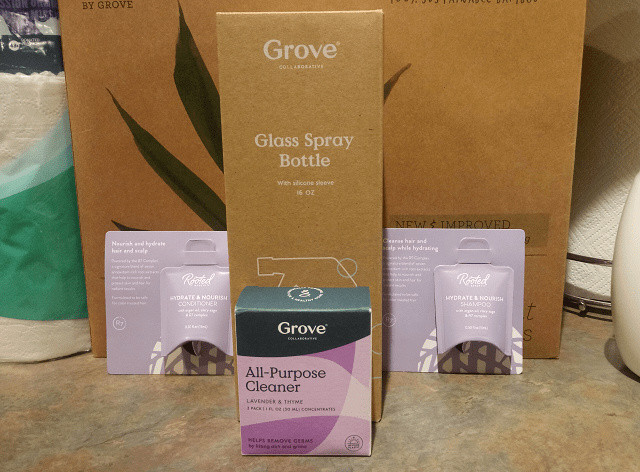
When you spend over $70 on any order, they send you full-size samples of some of their products.  I’ve received a cleaning caddy, tea towels, a bamboo dish scrubber, natural face wash, etc.  It’s a great way to try new products and see if you like them without any commitment. This month, I received this glass spray bottle, all-purpose cleaner, shampoo and conditioner samples free with my order.

Personal Touch

Every box that I receive from Grove has a personal, handwritten message on it.  They carefully tape the soap lids closed, so nothing spills in the box.  They arrive quickly, and the one instance when I had a problem with an order, I contacted customer service and they credited my account for the cost of the entire order.  I don’t feel that I get that kind of service from most companies these days.

That’s my shameless plug for Grove Collaborative.  I hope you give them a try and enjoy their products and service as much as I do.

History Project: Make Your Own Quill Pen & Ink

Make Your Own Quill Pen & Ink

Last winter, we were studying the early modern period in our homeschool, so we decided to do a project that would help us to experience what life was like during this time in history. We wondered how much more work it may have been not to have a modern pen to write with, but to use a feather quill instead.

Here is the link to read the rest of this post that I wrote for the Homeschooling with Heart blog.

Make homemade ink and quill pen

After writing this post, we found a turkey feather and had a chance to make our own quill pen.  We used these instructions, which were helpful, because they have detailed pictures on shaping the tip of the pen.  It’s tricky to get the shape right, and some sharp tools are required, so your child will need assistance with this.  I also do recommend heating the tip of the quill in the sand, as described in my Homeschooling with Heart post, before you attempt to shape it.  This will make the tip easier to work with.

homemade quill pen

It takes a lot of practice to get the hang of writing with a quill, but we definitely enjoyed doing these projects together.

Pulling Back the Veil on Comprehensive Sex Education

Comprehensive sex education

Recently, a teacher in Philadelphia made waves when he posted a series of tweets about how uncomfortable he was teaching through distance learning this fall.  His concern was that he would not be able to have honest conversations with his students about issues like gender and sexuality, knowing that the children’s parents might overhear.  He said that he operated on a “what is said here, stays here” premise within his classroom.  Personally, I feel that if a teacher is not comfortable with the content of a conversation with a student being overheard by their parents, then they probably shouldn’t be having the conversation in the first place. 

This reminded me of an article that I read a few years ago.  A school district was planning to implement a new sexual education curriculum and it was available at a meeting for parents to peruse.  Only one parent showed up, and she was appalled when she read it.  She took photos and posted them to the internet so other parents would be aware.  The curriculum, which was intended for middle-schoolers, gave explicit instructions on how to perform every sexual act imaginable, along with crude illustrations and jokes, which made light of the whole subject.  While researching this, I found numerous articles about today’s sexual education and reservations that parents have about it, from California1, Washington State2, Scotland3, Canada4, and South Africa5, among others.

When I was in school, sexual education included learning the basic scientific facts of reproduction, the risks involved, and how to avoid disease.  I also remember our teacher explaining to us how serious a responsibility it was to become sexually active and how it was not something to rush into before one was ready or to allow oneself to be pushed into.  However, in recent years, the United Nations has been encouraging countries to adopt something called “Comprehensive Sexual Education,” which focuses more on the pleasure aspect and appears to encourage sexual activity in minors.

If the material presented to children in school, by teachers whom they are taught to respect, makes it seem as if sex is not something to be taken seriously, that is likely to affect their attitude about it.  They may even feel like a “prude” if someone pressures them to engage in sexual behaviors that they don’t want to.  Besides the negative emotional consequences that a child may experience as a result of early sexual activity, it could also open children up to exploitation.  Kim Wendt, co-founder of Informed Parents of Washington, told The Christian Post that Seattle-area police officers who have worked in the human trafficking division, after viewing content in the CSE curriculum in her state, say the material mirrors how traffickers groom their child victims to enter the sex trade2. In Canada, there was a scandal over the development of their CSE curriculum, because it was overseen by a deputy education minister who was later convicted on charges of creating and possessing child pornography and counseling another person to commit sexual assault on a child4.  

As a Christian, I want my children to have a biblical view of this subject, and I believe the responsibility of having these conversations should fall on the parents.  Teaching the basic biology in school is one thing, but indoctrinating children into a worldly view while putting them at risk of abuse is another.  I am grateful that I am homeschooling my two school-aged children, so that I can introduce this subject in the way that I deem best.

Having already raised two children to adulthood, I do not believe that there is a specific age at which all children need to learn about sex.  They are individuals and will begin to ask questions at different ages.  The only aspect of it that I make a point to instill in my children at a young age is that there are parts of their bodies that are private and that other people should not touch, and that they should tell me if anyone does.  Aside from that, I do not push information on them that they aren’t already expressing curiosity about.

When your child begins to ask questions, there are many book series out there by Christian publishers that give varying degrees of information, depending on the age of the child.

With the recent pandemic, many parents are now choosing homeschooling, and for some, it is only temporary.   There are also homeschoolers who enroll their children in school when they reach a certain grade.  This is a good time for them to take this into consideration.  If you are planning on sending your children to public school at some point:

  1. Look into what sex ed curriculum your school district is using and address any concerns you may have about it with the principal.  Some have links to their curriculum online, where you can view what is going to be covered and at what grades. 
  2. If it does not meet your standards, find out if you can request that your child opt-out of the class.
  3. Make sure that your child has a solid grounding in the biblical view of sex first, in an age-appropriate manner.   
  4. Teach your children why you believe what you believe.  I attended a Christian elementary school and was taught many things from a biblical viewpoint that, when I entered public high school, were challenged, and I had no rebuttal to.  I try to prepare my children for the things that they will hear from the world and explain that they are not part of God’s plan.

Shortly after I was born again, I heard a sermon in which the pastor explained that God is not trying to be a bully or ruin anyone’s fun by putting limits on our sexuality.  He, as our Creator, designed it a certain way, as a good thing, and Satan tries to distort it into something wrong.  When we go outside of God’s will, we experience hurt that He never intended, so God’s limits are for our protection.  He specifically pointed out how the Bible describes the sex act as “becoming one” (Mark 10:7-8) with another person and how this explains why, when a relationship ends, the pain of that can feel like losing one of your own limbs.  As a young woman who had experienced that hurt myself, it finally all made sense to me, and I was able to begin the process of surrendering this area of my life to God.

Unfortunately, in today’s world, the stakes are even greater.  With online predators who target children, pornography available at the click of a mouse, and human trafficking as a growing problem, it is more important than ever that our children are grounded in the Truth, what behavior is of God and what is not, so that no one is able to take advantage of them or lead them astray.

“But whoever causes one of these little ones who believe in Me to sin, it would be better for him if a millstone were hung around his neck, and he were drowned in the depth of the sea.” – Matthew 18:6

“Let the little children come to Me, and do not forbid them; for of such is the kingdom of God.” – Matthew 10:14

  1. Mary Margaret Olohan, “Here Are the Details on California’s Sex Education,” Daily Caller News Foundation, July 8, 2019
  2. Brandon Showalter, “Parents Push Back Against Wash State Sex Ed Bill; Gov Expected to Sign,” The Christian Post, March 10, 2020
  3. Dorothy Cummings McLean, “Scots Protest New Sex- Ex Curriculum that Forces Children to Endorse Sexual Choices of Adults,” LifeSiteNews, September 16, 2019
  4. Joe Warmington, “Liberals Can’t Deny Levin’s Role with Sex-Ed Curriculum,” Toronto Sun, March 3, 2015
  5. Tom Head, “Controversial Sex Education Curriculum Faces Parliamentary Review,” The South African, October 31, 2019