It’s Time to Start Seeds!

green grass close-up in spring

As spring approaches, I am looking forward to what has become a homeschool ritual for us at this time of year – starting seeds.  When my son was in kindergarten, I decided that would be a good science lesson for him.  However, it became a learning process for me as well.

After growing seedlings indoors, we ended up transplanting them outdoors after the ground thawed.  We learned about caring for the garden, when to harvest the fruit and vegetables, and finally, how to save seeds for the next year.  Each spring, we begin the process again and try new things.  We experimented with starting the seeds in different types of containers, growing various types of plants, and planting them in the garden in new ways.  We have tried a raised pallet garden, container planting, and a hugelkultur.  We learned how to compost.  We fought with powdery mildew, blight, pests, and made homemade sprays to deal with some of these issues.  We learned about pollination and even hand-pollinated some squash.  We expanded our garden last summer and let the area that comprised the original garden lay fallow.  This summer, we will test whether that has a positive impact on our plants.

If you would like to try seed-starting with your children:

  1. Find out your plant hardiness zone to figure out what seeds to plant and when.
  2. Gather supplies.
    1. Pick a container. You can order a seed-starting kit, use egg cartons, Styrofoam cups, peat pots, etc.
    2. Pick seeds. Tomatoes, peppers, eggplant and some flowers are often started inside.
    3. Pick up some seed-starting soil. You can make your own or buy it, but it is different than regular potting soil.
    4. Download one of the free plant life cycle worksheets or seed journals that are available online to teach your children about the process.
  3. Place some soil in your chosen containers, water well and add a seed to each. Push carefully into soil.  Cover with plastic wrap.  Prick small holes in the plastic wrap as well as the bottom of your containers for drainage.  Keep in a warm spot or place on a seed heating mat.
    1. Label each seed! We write on plain popsicle sticks that we insert in the soil.
    2. Water often, but use something with a gentle flow, to avoid displacing seeds. We’ve used a spray bottle or a water bottle with a small hole made in the cap.
  4. Once the plants emerge, remove plastic wrap and move into a sunny spot.
  5. When the seedlings get their second pair of leaves, move to larger pots with plenty of compost.
  6. If you are going to transplant to the garden, harden them off about a week before planting.

Of course, not everyone has a backyard that is large enough for a vegetable garden.  One friend of mine starts seeds with her children indoors and they watch the seedling grow, but the process ends there.  Another grows her plants in containers.  There are many ways to incorporate it into your homeschool, regardless of whether you live in a rural or urban area.

I have found it to be such a rich learning experience.  Not only is it hands-on, but it inspires awe in the perfection of God’s creation and His provision for us.


Don’t Marry Your Method!

happy school girl on math classes

As I was preparing to embark on my homeschooling journey, I read books, consulted veteran homeschooling moms, and gathered materials.  One of those items was a set of vintage readers that was recommended for practicing oral reading.

I purchased another book to teach phonics, so we focused on that first.  My son hated it, though!  For a while, we tried practicing small passages in the reading primer instead, which he preferred.  Eventually, I resorted to splitting our time equally between the two books.  After all, the phonics curriculum had come highly recommended and I’d spent money on it.  I should use it; right?

This school year, we finally abandoned that phonics book in favor of the preferred vintage readers, and he is making significant progress.  I toyed with the idea of ditching his spelling curriculum, too, and just focusing on the new words introduced at the beginning of each lesson in his reader.  Again, though, I thought, “But I spent money on that spelling book,” and he didn’t dislike it.  As our year wore on, though, I didn’t think that he was making connections between the words in the spelling lessons when he would encounter them in other reading material, so I decided to revisit the idea of using the readers for that purpose.

As I searched for direction on how to do that, I discovered the original teacher’s manual online.  I discovered that the series was designed not only for teaching reading, but also spelling, grammar, vocabulary and composition and it seemed to me that the publisher’s intent in how they were to be utilized made perfect sense.  I believed it would be more helpful to him than what we’ve been doing so far, so I began the new year with this method.

I have asked myself why I fought these changes.  I know that I was afraid of steering away from curriculum with the teaching steps explicitly provided for me as well as overlooking the recommendations of other moms that I respect.  While reading the manual, this comment leapt out at me, “…we wish to warn the young teacher especially of the danger that the method will become a hobby unless he is careful, and that thus the end will be lost sight of in attention to the means.” 1  Consistency is important, but if what you are doing isn’t working, maybe you are putting too much faith in your curriculum, your teaching philosophy, someone’s advice, or valuing the money that you spent on that book a bit too much.   Depending on where your heart is, any of those excuses could actually be idolatry in disguise.  In the end, as I prayed for direction, God just steered me back to where I needed to be.

Maybe you have less of a tendency to get stuck in one way of thinking than I do.  If you’re like me, though, beware of marrying your method (or curriculum)!  In the end, consider what works for your individual child, pray on it and trust the leading that you receive.  Don’t be afraid to make changes.  It may be exactly what you and your child need.


1 The Eclectic Manual of Methods for the Assistance of Teachers.  Van Antwerp, Bragg & Co., 1885.

Maintaining a School Routine before Christmas

Golden christmas star

The homeschool community is a diverse group.  With all of the possible approaches, from classical education to unschooling, and the freedom to make your own schedule, school often looks very different for one family than it does for another.  The beauty of that is the ability to find what works for you, and that flexibility can come in handy at times.  For instance, when my husband was too busy to take time off from work this summer, we simply postponed our family vacation until October.  Homeschool families can do that!

pinkk flowers

I have found that what works best for us is having a set routine.  What that routine is can change from year to year and be adjusted as needed, but it is much less stressful for me and my children if we have a plan for each day.   Usually, this means getting up at pretty much the same time, eating breakfast, getting dressed, and beginning our school day at a set time.  The main reasons this works for us are:

  1. My children tend to cooperate more and offer less resistance to transitions when they can anticipate the next step. Knowing that there is an order to their day gives them a sense of security.  Leaving things too flexible makes them behave in an aimless manner – wanting to do one thing one moment and something completely different the next, while leaving a trail of toys behind them!  They’ll also fight requests to sit down and do seatwork, because they think that they can talk me into something else.
  2. Unexpected obstacles WILL happen sometimes. When we returned from our vacation on a Sunday evening, I tried to start school up again on Monday morning.  However, because we’d been away for a week, there was hardly any food in the house, so a supermarket trip interrupted our school day.  The next day was a holiday.  We still did school, but there were some preparations that needed to be done for that.  Next, my little one tripped and smashed her face into the kitchen floor.  A visit to the pediatrician and the ear, nose and throat doctor rounded out my week.  Then, both of my children caught a cold.  Some weeks are just like that, and if we hadn’t been productive in the weeks leading up to that crisis week, I would have been even more stressed.  Knowing that we are sticking to a schedule the rest of the time helps me ride out the crazy weeks a little better.

With the holiday season approaching, I know that there will be days that sticking to the regular schedule will be difficult.  Generally, the week before Christmas, we follow an adjusted schedule that looks something like this:

  • We continue to get up, get dressed and start school at the same time, although we usually make this week “half days.”
  • We have a lovely K – 3 Christmas learning packet that incorporates language arts, math, copywork, art and the Christmas story. I place whatever pages are grade-appropriate for the child in a binder and they take out their binders in the morning and we do a little from each subject area.  They enjoy the change from their regular curriculum, but they are still learning.
  • We spend time reading about the birth of Jesus and discussing it.

The goal is to keep things as normal as possible, so the transition after the holidays is smoother.

How do you handle the busy week before Christmas?  Do you stick to your regular schedule or do something completely different?


Using Guided Repeated Reading to Improve Fluency

Smart girl

I am in my fourth year of homeschooling my son and learning to read has been a slow process for him.  He’s made a lot of progress recently, but the one remaining obstacle that I see is for him to achieve enough fluency to feel confident reading in public.  In co-op, Sunday school or other activities, he avoids reading.  He confided in me recently that he doesn’t want to read in front of his peers because he still needs to sound some of the words out.  Most of the children that he encounters around his age don’t have to do that.

As a result, I decided that helping him to be a fluent reader needs to be our top priority right now.  I don’t want him to miss out on participating in activities that he enjoys.

We’ve often used the McGuffey’s Readers for oral reading practice, and years ago, I read on another mom’s blog that she had her children read the same lesson from a McGuffey’s Reader for five days in a row.  At the time, I was confused as to why she did that, as the lessons in the early readers are short and sweet.  As I searched for information on improving fluency, though, I discovered why – Guided Repeated Reading.  While our phonics curriculum had new passages to be read by my son each day, Guided Repeated Reading has the child read the same passage over and over until they can read it without hesitation, even if it does take five days.  The steps that we have been following are:

  • Practice reading for 30 minutes per day
  • Have the child read the same passage at least 4 times in a row
    • Supervise and make gentle corrections when needed
  • Read the passage aloud for the child at least twice to model fluent reading for them

pinkk flowers

One piece of advice that I’ve read is to model the passage at the outset of the lesson rather than having them sound it out first.  The idea is that having familiarity with it removes any anxiety that your child may have about approaching new text.  I see value in that idea, but my child is used to doing memory work (such as poems and Bible verses) and I notice that if I read through the passage for him first, he appears to be reciting portions back to me from memory, which isn’t reading.  For that reason, I have been having him sound everything out initially and then modeling it for him after he has gotten through the whole thing once on his own.

Within 3 to 6 months of following this protocol, your child’s reading is supposed to greatly improve.  We’ve been using this method for about six weeks and I can see evidence that it is working.  I’ve noticed a few improvements in particular:

  1. When he encounters a word that he has mastered in a passage that we’ve previously worked on, he often remembers the word on sight now, rather than having to sound it out as though he is seeing it for the first time.
  2. If we return to a passage that we’ve already done and moved on from, he can still read it easily.
  3. He’s becoming braver about attempting to read unfamiliar words in other situations.

Over the course of time that we’ve been doing this, he has gone from needing about three days on a new passage to being able to master it almost completely in one sitting.

If reading fluently is a struggle for your child, you may want to consider using Guided Repeated Reading as a tool to help them.

Sight Word List for The Ordinary Parent’s Guide to Teaching Reading

Happiness

The Ordinary Parent’s Guide to Teaching Reading (OPGTR) is a phonics curriculum written by Jessie Wise.  You can read my review of it here.  In this book, the focus is on learning to read by sounding words out, so the number of “sight words” that children are asked to memorize is minimal.  However, at some points in the book, common words that do not follow regular phonetic patterns or follow patterns that will be introduced later in the book are written down on index cards and introduced to the child to be memorized.

This year, my husband and I set up an official classroom for our children, and in the process of moving things, I misplaced my OPGTR sight word cards.  I resisted making new ones at first, convinced that they would turn up as soon as I did so.  As we are in November now, I decided to give up waiting and made new ones.  I searched through my book to see if there was a complete list of the cards in there, but there wasn’t.  I searched online to see if anyone else had compiled one.  No luck!  As a result, I had to sit down with the book and look at each lesson, one by one, in order to make sure I didn’t miss any of the words.  After all of that work, it occurred to me that there has to be at least one other parent out there who has had this same experience.

pinkk flowers

As a result, I have decided to share this sight word list.  I’ve also added the lesson number at which each word is introduced.

Lesson Number Word Introduced
29 the
31 I
36 a
50 of
66 have
70 give
76 to, two, too
91 do, who
92 friend
95 eye
97 buy
99 was
100 shoe
114 could, would, should
126 said
129 one, once
131 build, built
141 laugh
148 what, does
150 gone
156 are
173 where, there, were
174 their, here
189 choir
194 people
198 been
200 busy
217 only

I hope that you find this helpful!  I know that I am going to use it as a reference if my sight word cards wander away again.

Relationship, Obedience & Homeschooling

Relationship obedience pic for blog

Recently, as we were waiting for our daughters at dance class, another mom asked if my children had started school yet.  I explained that we had begun our school year, but we homeschool.  In response, she said, “I thought about homeschooling, but in the end, I decided that my relationship with my children would be better if I weren’t their teacher, too.”

A few years ago, a friend of mine who was considering homeschooling her child shared with me her worry that her son wouldn’t listen to her if she tried to teach him, and therefore, not get his school work done.

I cannot judge either one of these concerns.  I understand them well, because I’ve had them myself.  As I’ve prayed through them, though, God has shown me His heart about these things.

Relationships require interaction and time spent together to grow in intimacy, not time apart.  The reason that “absence makes the heart grow fonder” isn’t because you love someone more when you are apart; it is because the less you are together, the less opportunity there is for conflict to develop.  God’s Word shows us that He is very relational.  He is our Abba Father.  Jesus is His son.  The church is called His bride.  How can we model for our children an intimate relationship with God unless we have one with them?

Also, it is very important that we all learn obedience to God.  How do we prepare our children for that responsibility if we haven’t taught them to obey us first?  Personally, I’ve been very frustrated by a stubborn disobedience that has arisen in my 6-year-old lately.  I warn her that there will be consequences if she doesn’t make the right choice in a given situation.  Yet, she continues to push the limits until I end up having to take a privilege away.  Then, the tears flow, as though she didn’t already know that was going to happen.

I don’t want to chasten my children or remove blessings from them.  However, this helps me to realize how God feels about me.  He wants my obedience and for me to listen to His leading, so he can bless me also.  That just confirms to me that I need to stick with it.  My daughter will find it much easier to follow God in the long run if she gets her heart right in this area now.  It also helps me to keep my eyes on Him in my own walk.  If it hurts me this much to punish my child, I can imagine how much more my Father in heaven is grieved by me at times.

If I weren’t home with my children all day, I’d have a lot less time to help them build their characters and encourage their spiritual growth, but it would still be my responsibility, even if someone else was teaching them to read and write.  So, I embrace the challenge, trusting that God will work in their hearts to bring them closer to Him.

“Then I will give them a heart to know Me, that I am the Lord; and they shall be My people, and I will be their God.” – Jeremiah 24:7

 Note:  This post was written for The Old Schoolhouse® Magazine’s Homeschooling with Heart Blog and the intended audience is parents who feel that they have been called to homeschool.

The Specks in History

The Specks in History Graphic 1

A couple of years ago, my husband and I took our children on a field trip to see the Liberty Bell in Philadelphia.  When we exited the building, there was a television monitor outside loudly playing a video disparaging one of the founding fathers.  We hurried the children away from it.  It just felt wrong to me.

With the recent stories in the news about statues being torn down by angry mobs, I’ve given this some more thought.  As a homeschooling parent, it begs the question, “What is the right approach in teaching my children about historical figures?”

I suspect that the reason that there is so much vitriol towards some of these people is because the tendency in the past has been to venerate them and hold them up as examples to our children.  I can understand why that would have happened.  How better to inspire children to use their God-given gifts to the utmost and not settle for mediocrity than to give them an accomplished person to emulate?  The pushback to that in recent generations seems to be to point out their every moral failing, as if to make them pay penance for their fame.

As a Christian, I believe my job is to teach my children to idolize and imitate only one human being – Jesus Christ.  Anyone else, successful or not, is only another sinner just like them.  Even public figures that are generally admired by most of us still have hidden sins, as do we.  No one has attained perfection.

I want to teach my children both by my words and my example to emulate Jesus.  In order to do this, I have to follow His commands.  That includes not attempting to remove the speck from someone else’s eye when I have a plank sticking out of my own eye (Matt. 7:1-5).  It also means that I should not cast the first stone, when I am not without sin myself, and that I should treat others the same way that I want to be treated (John 8:7; Matt.7:12).

I also think that it’s a good idea to provide balance in our history lessons; presenting both what someone may have done that was right versus mistakes that they made.  There has to be a line, though, where I determine what information is useful for them to have and what is just tabloid fodder.  One thing that I find helpful is to take off my 21st century lens for a moment and look through the lens of the time period we are studying.  Every generation has their predominant sins.  There are things that were accepted in the past that appall us, but if the people living in that time were able to look forward to practices that are generally accepted today, they’d find plenty to be appalled with as well.

After I’ve removed and carefully examined the plank that was in my own eye, it makes me a lot more humble and less likely to harshly point out the speck in another’s eye.  If the person is deceased, what can be accomplished by pointing out their failings at all?  In the end, I wouldn’t want my own sins blaring from a TV into the streets of Philadelphia, so I won’t do that to someone else.

“Judge not, that you be not judged.  For with what judgment you judge, you will be judged; and with the measure you use, it will be measured back to you.  And why do you look at the speck in your brother’s eye, but do not consider the plank in your own eye?  Or how can you say to your brother, ‘Let me remove the speck from your eye’; and look, a plank is in your own eye?  Hypocrite!  First remove the plank from your own eye, and then you will see clearly to remove the speck from your brother’s eye.” – Matthew 7:1-5

Awakening – Letting Children Develop at Their Own Pace

lily photo 2

This summer, I discovered something new in our yard – a beautiful, yellow lily with a burgundy center.  In the decade that we’ve lived in this house, it had never bloomed before.  About a week later, a solid yellow lily appeared in another part of the yard.  A friend had given me some flower bulbs about two or three years ago, and I planted some in both of those locations.  After the first summer had come and gone without anything appearing, I’d given up hope on them, but they’d been alive in the earth all along.  My husband thinks they came up now because our neighbor cut some trees down and we are getting more sunlight.  Whatever the case, they apparently needed time and the right conditions to bloom, and this was their year.

Not long after this, another miracle occurred; my son, who is seven, turned to me and said, “Mom, I’ve been noticing something lately.  I know how to read now.”

I’ve been trying to teach him to read for about the same length of time that those bulbs have been underground, and until recently, the fruits of my labor had not seemed very productive.

When I made the decision to homeschool him, a veteran homeschool mom told me, “Don’t worry if he is slow to read.  Several of my children have been, but they all got it eventually.”  I nodded and smiled, thinking that I didn’t need to worry about that.  After all, I could read at age three, and my two older children, who’d gone to school, were reading in first grade.  Why should he be any different?

When we began his phonics instruction in kindergarten, he was making good progress until he actually had to begin blending the isolated sounds that he’d learned into words.  No matter what I tried, he just could not “hear” the blend.  I was set on following the curriculum to the letter, and he was getting frustrated by the amount of practice that was required by each lesson.  By the time that he was able to blend, he had developed a dread for reading and a lack of confidence in his ability, no matter how much I tried to encourage him.  To make matters worse, a friend of mine noticed his inability to read and began to question me about it, periodically suggesting that I ought to put him in public school, which made me feel even more defeated.

When he reached second grade, I knew that I needed to try something different.  Some days we did a lesson out of the phonics book, and on alternate days, we used a vintage reading primer that he enjoyed and felt less intimidated by.  His sister was beginning kindergarten, and she quickly began to catch up to him.  When he realized this, an internal motivation emerged from him not to let her out-do him.  His cooperation improved, but he still needed to sound everything out slowly, letter by letter.

I prayed for a breakthrough and continued to have him practice this summer with some easy readers.  One day, I noticed that he was beginning to finally see what some of the words were on first sight, without having to sound them out.  Now, the day had come when he realized what that meant.  He was finally a reader.

I should have listened to that mom years ago, when she tried to impart some wisdom from her own experience.  Children develop at their own pace.  Rather than wasting time worrying or letting my pride be injured that my child wasn’t doing something at the same time that other children are, I should have just turned my cares over to God and had confidence that my son would bloom when the time was right.  Just like the lilies in my garden, it was a lovely surprise when it happened.

“Consider the lilies of the field, how they grow: they neither toil nor spin; and yet I say to you that even Solomon in all his glory was not arrayed like one of these.  Now if God so clothes the grass of the field, which today is, and tomorrow is thrown into the oven, will He not much more clothe you, O you of little faith?” – Matthew 6:28-30

How We Use “The Ordinary Parent’s Guide to Teaching Reading”

Reading time

I am now in my third year of homeschooling.  My son is in second grade and my daughter is in kindergarten.  I have been using “The Well-Trained Mind” by Susan Wise Bauer and Jessie Wise as my basic guide.  With that in mind, I purchased the text that she suggests, “The Ordinary Parent’s Guide to Teaching Reading” (OPGTR) by Jessie Wise and Sara Buffington to teach phonics to my children.

I began kindergarten with my son right as he was turning five.  We initially followed the scripted lessons in OPGTR to the letter.  In the beginning of the book, where the short vowel and basic consonant sounds were introduced, he participated enthusiastically and my three-year-old joined in.  However, once the book began to introduce sentences for him to read to practice the sounds he had learned, things began to go downhill from there.  Long story short, I ended up spending more time fighting with him to convince him to do the lesson than we actually did on the lesson itself.

pinkk flowers

I still believed in the curriculum.  The scripted way that the lessons are presented makes it easy to use and I like the thorough way that each sound is described.  The problem seemed to be that my son was intimidated by the amount that he was being asked to read.  I consulted some online homeschooling boards for suggestions from other parents and found that others had experienced similar issues with their children.  Some of the ideas that I tried were:

  1. Writing the words or sentences that the child is supposed to read on a chalkboard or whiteboard, word by word or sentence by sentence instead of having him reading right out of the book.
  2. Splitting some of the longer lessons over two or three days.
  3. Eliminating or shortening some of the sentences.
  4. Taking a break from the book for a while and using easy readers for practice in the meantime.

After trying all of these suggestions, we were still trudging our way through the OPGTR at the beginning of second grade, by which time I believed that he should have been finished with it and reading independently.  It was a battle every time the book came out and I tried to sit him down to a reading lesson.  You may think that I should have given up on it by now.  However, when I tested my daughter to see at what point in the book I should start with her, knowing that she had had some exposure to it, I was surprised to discover that she already knew all of her basic consonant and short vowel sounds, meaning that we were able to skip past the first third of the book.  Obviously, it had been beneficial to her, just from listening in on her brother’s lessons.

With that in mind, I finally devised a way to motivate my son to practice reading without a fight but still finish up the curriculum.

  1. We follow the scripted lesson which explains each phonics rule and read the words which utilize the sound.
  2. I read the sentences to him/her, pointing at each word as I say it, and making them follow along with their eyes.
  3. We practice reading sentences in books that he is not intimidated by.
    1. Mainly, we use the McGuffey’s Primer or First Reader (which can be purchased here or downloaded for free here).
    2. Bob Books
    3. Hooked on Phonics readers

As I am embarking on this book anew with my kindergartener, I’ve also taken into account some mistakes that I made the first time around.  Because getting my son to complete a lesson was such a battle, I ended up skipping some of the steps that the book suggests for lack of time.  Now that I am now longer requiring him to read all of the sentences, he is cooperative and we actually have the time to do these things:

  1. The One New and Two Review rule. Basically, this means that you do a quick synopsis of what the child learned in the last two lessons before embarking on the new lesson.
  2. Sight Words. The OPGTR doesn’t encourage sight words as a rule, but introduces them periodically when a word is “disobedient,” meaning that it doesn’t follow the basic phonics rules, or if the word is a common one (like “the”) that cannot be sounded out.  We make a flash card as the book directs us to and then review them several times a week.  My children like to play a game that whoever reads the most sight words first gets a treat.  (This post lists the sight words introduced in the book in order.)

I decided to share what has worked for us because I’ve seen so many parents lament that although they like this curriculum, their children hate it and they have the same battle of wills going on that I did.  If my experience can help someone else to be successful with it, that will make all of the trouble I experienced at first worth it.  On another note, knowing what I know now, I probably would not have started kindergarten with my son until he was six and not put as much pressure on him to read right away.  Research suggests that girls tend to find learning to read easier than boys and many children aren’t ready for formal schooling at five years old.  “The Well-Trained Mind” takes the approach that once a child learns to read, the whole world of learning is open to them.  While I agree with the idea, if pressing the child to read when they are not ready makes them resistant to learning in general, then it does more damage than good.

All in all, I do recommend this book to other homeschooling families, keeping in mind that they may need to use some of the above-mentioned strategies if their child struggles with it.

Note:  I wrote this towards the end of last school year.  Over the summer, I kept having my children practice reading in some easy readers and my son has made significant progress and gained confidence in his ability to read!  I also discovered that The Ordinary Parent’s Guide to Teaching Reading is supposed to lead to a fourth grade reading level once the child has completed it.  I feel that the edition of The Well-Trained Mind that I have was not clear on this.  Knowing that, I feel better about the amount of time it has been taking us to work through the book.

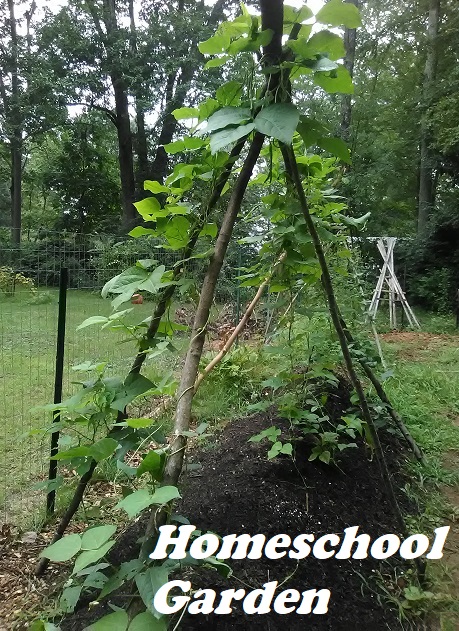
Homeschool Garden

Hugel Culture with text

Last year, I planted a vegetable garden.  It was only my second year doing this.  I grew up in the city and don’t know much about gardening.  However, while homeschooling my son, we learned about sprouting seeds and the garden seemed like the next logical step.

In our family, we try to live pretty naturally.  I cook from scratch and avoid artificial ingredients.  So, if I was going to grow food for us, I wanted it to be as organic as possible.  I saved seed from plants I had grown the year before, used our compost, fertilized with manure and Epsom salts, deterred pests with crushed eggshells and cups of beer planted around the raised beds.

Every morning, I went out, watered my plants, pulled off any powdery mildew-infected leaves, picked anything that was ripe, tied or propped up anything that needed it.  I said to my husband, “This is like having a baby, except that it doesn’t wake me up at night!”

However, as I looked at the gardens of my neighbors, I sometimes got a little envious.  I had put so much tender care into my little plot of land, and theirs had grown so much bigger, faster, and yielded so much more food already.  Sometimes, it was discouraging and made me wonder if it was worth it to do things the way that I had chosen to do them.

That thought process took me right back to parenting again.  When my youngest was born, I wanted to breastfeed her, as I had with my other children.  The fact that she was premature and had an immature immune system was an additional motivating factor.  Luckily, I knew ahead of time that she’d be delivered early and had read up on strategies for nursing a premature baby.  It was NOT easy, though.  She was too small and weak to nurse directly and had to be tube-fed the milk that I was pumping for her, every 2 to 3 hours, around the clock.  I set an alarm to wake myself at night and delivered all of the little, carefully labeled bottles to the neonatal intensive care unit every morning.

One night, I stayed overnight at the NICU so I could spend extra time with my baby, trying to teach her to nurse.  As I attempted to get some sleep, I overheard the nurse who was responsible for my daughter that night speaking with another nurse, mocking my attempts to breastfeed a preemie, which she presumed would fail.  It was devastating.  I was just trying to offer my child what I thought was the best that I could and frankly, one of the only things I could do to nurture her while she was still in the hospital.  Who could find fault with that?

After a month in the hospital, my baby returned home on a bottle.  I spent three more months on the roller coaster of pumping milk around the clock while also trying to help her get the hang of nursing.  I made more than one tearful phone call to the lactation consultant, and eventually found myself grumbling over having to stop everything to pump throughout the day, while keeping a newborn and toddler happy at the same time.  At times, I thought how much easier it would be just to give up and turn to formula instead.  It wouldn’t have been the end of the world.  I had made a choice to breastfeed, though, because it was what I felt was best for her.  No one was forcing me to, so what right did I have to complain?

It wasn’t long after this realization that she finally got the hang of nursing, and rejected the bottle feedings for good.

I can draw the same comparison to homeschooling.  When I was considering taking on the challenge, a homeschool veteran that I knew gave me the wise advice that it was something that God had to call you to.  I prayerfully considered this and determined that He was.  Over the last three years, I have found a lot of joy and blessing in the experience of teaching my children.  It has inspired me to recognize the many teachable moments that present themselves throughout the day, even when we aren’t “schooling.”  It has challenged me and helped me to grow.

It isn’t easy, though.  It requires effort and sacrifice.  Sometimes, it is very frustrating and my patience wears thin.  It can be tempting to look at the garden across the street, with the “miracle” grown, heavy-laden plants and think how much easier it would be to take that path and how much better the short-term results appear to be.

Then, God reminds me, “If I’ve called you to it, I’ll equip you to do it.  You made a free will choice to follow the path I set before you.  Are you going to trust Me or grumble about it?”  That’s when He reminds me of some things.

  1. Faster isn’t necessarily better. Three of my four children attended preschool, but I kept the youngest home with me, because the cost had become too high.  When I began kindergarten with her, I discovered that she was farther ahead in some areas than her siblings had been at the same age.  Beginning school two years later had not hurt her at all.
  2. Anything that is worth doing will never be easy. When I first got saved and the realization hit me that I was supposed to surrender my love life to God and remain pure until He brought me a husband, I didn’t think it would be easy, but I never comprehended how challenging it would be.  Not only was there physical temptation to combat, but the fear that no one would ever want to marry me.  Looking back now, the only regrets that I have from that time are the moments when I failed to be strong and compromised in some way, and there were always ramifications from those choices.  The times when I walked in complete purity were worth the sacrifice.
  3. We have to take responsibility for what God has entrusted us with. This won’t be the same for all of us.  Some parents have obstacles that prevent breastfeeding, homeschooling, or growing their own food.  Some people just aren’t called to those things, or perhaps aren’t in this particular season of their lives.  We aren’t all meant to walk the same exact path at the same time.  We should still strive to be faithful in whatever circumstance we are in presently.  No matter who is teaching our child to read and write, we still have a responsibility to teach them about Jesus, to treat others as they would like to be treated, and to be grateful for the blessings they have received.

So, when I am tempted to look upon the garden across the street with envy, I remember these things.  My garden may take longer to grow and produce less impressive-looking food, but it will nurture the bodies of my family just as well.  So, I can rest easy, knowing that I have done it the way that I was called to, instead of taking a shortcut that I would have regretted.  There is something incredibly satisfying in that.