Sight Word List for The Ordinary Parent’s Guide to Teaching Reading

Happiness

The Ordinary Parent’s Guide to Teaching Reading (OPGTR) is a phonics curriculum written by Jessie Wise.  You can read my review of it here.  In this book, the focus is on learning to read by sounding words out, so the number of “sight words” that children are asked to memorize is minimal.  However, at some points in the book, common words that do not follow regular phonetic patterns or follow patterns that will be introduced later in the book are written down on index cards and introduced to the child to be memorized.

This year, my husband and I set up an official classroom for our children, and in the process of moving things, I misplaced my OPGTR sight word cards.  I resisted making new ones at first, convinced that they would turn up as soon as I did so.  As we are in November now, I decided to give up waiting and made new ones.  I searched through my book to see if there was a complete list of the cards in there, but there wasn’t.  I searched online to see if anyone else had compiled one.  No luck!  As a result, I had to sit down with the book and look at each lesson, one by one, in order to make sure I didn’t miss any of the words.  After all of that work, it occurred to me that there has to be at least one other parent out there who has had this same experience.

pinkk flowers

As a result, I have decided to share this sight word list.  I’ve also added the lesson number at which each word is introduced.

Lesson Number Word Introduced
29 the
31 I
36 a
50 of
66 have
70 give
76 to, two, too
91 do, who
92 friend
95 eye
97 buy
99 was
100 shoe
114 could, would, should
126 said
129 one, once
131 build, built
141 laugh
148 what, does
150 gone
156 are
173 where, there, were
174 their, here
189 choir
194 people
198 been
200 busy
217 only

I hope that you find this helpful!  I know that I am going to use it as a reference if my sight word cards wander away again.

Relationship, Obedience & Homeschooling

Relationship obedience pic for blog

Recently, as we were waiting for our daughters at dance class, another mom asked if my children had started school yet.  I explained that we had begun our school year, but we homeschool.  In response, she said, “I thought about homeschooling, but in the end, I decided that my relationship with my children would be better if I weren’t their teacher, too.”

A few years ago, a friend of mine who was considering homeschooling her child shared with me her worry that her son wouldn’t listen to her if she tried to teach him, and therefore, not get his school work done.

I cannot judge either one of these concerns.  I understand them well, because I’ve had them myself.  As I’ve prayed through them, though, God has shown me His heart about these things.

Relationships require interaction and time spent together to grow in intimacy, not time apart.  The reason that “absence makes the heart grow fonder” isn’t because you love someone more when you are apart; it is because the less you are together, the less opportunity there is for conflict to develop.  God’s Word shows us that He is very relational.  He is our Abba Father.  Jesus is His son.  The church is called His bride.  How can we model for our children an intimate relationship with God unless we have one with them?

Also, it is very important that we all learn obedience to God.  How do we prepare our children for that responsibility if we haven’t taught them to obey us first?  Personally, I’ve been very frustrated by a stubborn disobedience that has arisen in my 6-year-old lately.  I warn her that there will be consequences if she doesn’t make the right choice in a given situation.  Yet, she continues to push the limits until I end up having to take a privilege away.  Then, the tears flow, as though she didn’t already know that was going to happen.

I don’t want to chasten my children or remove blessings from them.  However, this helps me to realize how God feels about me.  He wants my obedience and for me to listen to His leading, so he can bless me also.  That just confirms to me that I need to stick with it.  My daughter will find it much easier to follow God in the long run if she gets her heart right in this area now.  It also helps me to keep my eyes on Him in my own walk.  If it hurts me this much to punish my child, I can imagine how much more my Father in heaven is grieved by me at times.

If I weren’t home with my children all day, I’d have a lot less time to help them build their characters and encourage their spiritual growth, but it would still be my responsibility, even if someone else was teaching them to read and write.  So, I embrace the challenge, trusting that God will work in their hearts to bring them closer to Him.

“Then I will give them a heart to know Me, that I am the Lord; and they shall be My people, and I will be their God.” – Jeremiah 24:7

 Note:  This post was written for The Old Schoolhouse® Magazine’s Homeschooling with Heart Blog and the intended audience is parents who feel that they have been called to homeschool.

The Specks in History

The Specks in History Graphic 1

A couple of years ago, my husband and I took our children on a field trip to see the Liberty Bell in Philadelphia.  When we exited the building, there was a television monitor outside loudly playing a video disparaging one of the founding fathers.  We hurried the children away from it.  It just felt wrong to me.

With the recent stories in the news about statues being torn down by angry mobs, I’ve given this some more thought.  As a homeschooling parent, it begs the question, “What is the right approach in teaching my children about historical figures?”

I suspect that the reason that there is so much vitriol towards some of these people is because the tendency in the past has been to venerate them and hold them up as examples to our children.  I can understand why that would have happened.  How better to inspire children to use their God-given gifts to the utmost and not settle for mediocrity than to give them an accomplished person to emulate?  The pushback to that in recent generations seems to be to point out their every moral failing, as if to make them pay penance for their fame.

As a Christian, I believe my job is to teach my children to idolize and imitate only one human being – Jesus Christ.  Anyone else, successful or not, is only another sinner just like them.  Even public figures that are generally admired by most of us still have hidden sins, as do we.  No one has attained perfection.

I want to teach my children both by my words and my example to emulate Jesus.  In order to do this, I have to follow His commands.  That includes not attempting to remove the speck from someone else’s eye when I have a plank sticking out of my own eye (Matt. 7:1-5).  It also means that I should not cast the first stone, when I am not without sin myself, and that I should treat others the same way that I want to be treated (John 8:7; Matt.7:12).

I also think that it’s a good idea to provide balance in our history lessons; presenting both what someone may have done that was right versus mistakes that they made.  There has to be a line, though, where I determine what information is useful for them to have and what is just tabloid fodder.  One thing that I find helpful is to take off my 21st century lens for a moment and look through the lens of the time period we are studying.  Every generation has their predominant sins.  There are things that were accepted in the past that appall us, but if the people living in that time were able to look forward to practices that are generally accepted today, they’d find plenty to be appalled with as well.

After I’ve removed and carefully examined the plank that was in my own eye, it makes me a lot more humble and less likely to harshly point out the speck in another’s eye.  If the person is deceased, what can be accomplished by pointing out their failings at all?  In the end, I wouldn’t want my own sins blaring from a TV into the streets of Philadelphia, so I won’t do that to someone else.

“Judge not, that you be not judged.  For with what judgment you judge, you will be judged; and with the measure you use, it will be measured back to you.  And why do you look at the speck in your brother’s eye, but do not consider the plank in your own eye?  Or how can you say to your brother, ‘Let me remove the speck from your eye’; and look, a plank is in your own eye?  Hypocrite!  First remove the plank from your own eye, and then you will see clearly to remove the speck from your brother’s eye.” – Matthew 7:1-5

The Baptism and Racism

ki85B6ybT

Last Sunday, we held an indoor immersion baptism at my church.  A large, metal trough was brought into the church and filled with water.  To be honest, I thought it was a little weird when I heard of that plan.  The experience far exceeded my expectations, though.  There was a brief sermon, and for the rest of the service, the worship team played while people lined up to be baptized.

Now, I’ve been to plenty of baptisms in my day – infant christenings where they sprinkle a little water on the baby’s head; lake, pond and even swimming pool immersions.  My pastor baptized me in a swimming pool at his parents’ house.  This was something altogether different.  It was as though there was electricity in the air last weekend.  You could just feel the Holy Spirit moving in a powerful way.  I was singing really loud, dancing in my seat, and I briefly thought about how, as a new believer, I would have wanted to let my hair down that way, but would have been afraid to.  Before I got saved, I would have been intimidated by that whole scene – people standing with their hands raised, etc.  Deep down, I would have known it was authentic, though.  It was that sort of feeling that hooked me when my Nana convinced me to visit her church one Easter, sixteen years ago.  The joy that I felt in that service was like nothing I’d experienced in my church upbringing.  This service blew that one out of the water, though.  I was giddy afterwards, and so was everyone else that I talked to.

For me, one of the beautiful things about it was seeing people of different races lined up together to get in the water.  I live in a very monochromatic area, so it is no surprise that our church has typically reflected that.  Having grown up in the city, that is not normal to me, though.  Our church has experienced a lot of growth over the past few years, and I believe it is a blessing that we are beginning to look more like a melting pot now.

After returning home that day and having some lunch, I made the mistake of getting on social media.  A friend from my youth, who has been actively posting a lot of political stuff lately, shared a clickbait article about some racist white woman with the commentary “I’m beginning to think they are all like this.”  Well, so much for feeling giddy.  It was bad enough that he was stereotyping me unfairly, but to make matters worse, this man is married to a white woman and his only child is half white.

I was tempted to respond, but I don’t believe you can talk someone out of prejudice.  Some people open their eyes eventually, but you can’t pry them open for them.  The conclusion that I came to is this.  What I witnessed in my church is what happens when we let Jesus have control.  He brings truth, love, unity, joy and peace.  People loving one another and rejoicing over their new brothers and sisters – that is what Jesus does.

Satan brings deceit, fear and hate.  When media outlets write and publish divisive articles that sacrifice unity on the altar of the god of mammon, it’s obvious who they are giving control to.  It’s sad that there are people who allow their view of the world to be shaped by that.

Personally, I’ll take Jesus.  The view from here is a lot sweeter.


“There is one body and one Spirit, just as you were called in one hope of your calling; one Lord, one faith, one baptism; one God and Father of all, who is above all, and through all, and in you all.” – Ephesians 4:4-6                                                                    

Awakening – Letting Children Develop at Their Own Pace

lily photo 2

This summer, I discovered something new in our yard – a beautiful, yellow lily with a burgundy center.  In the decade that we’ve lived in this house, it had never bloomed before.  About a week later, a solid yellow lily appeared in another part of the yard.  A friend had given me some flower bulbs about two or three years ago, and I planted some in both of those locations.  After the first summer had come and gone without anything appearing, I’d given up hope on them, but they’d been alive in the earth all along.  My husband thinks they came up now because our neighbor cut some trees down and we are getting more sunlight.  Whatever the case, they apparently needed time and the right conditions to bloom, and this was their year.

Not long after this, another miracle occurred; my son, who is seven, turned to me and said, “Mom, I’ve been noticing something lately.  I know how to read now.”

I’ve been trying to teach him to read for about the same length of time that those bulbs have been underground, and until recently, the fruits of my labor had not seemed very productive.

When I made the decision to homeschool him, a veteran homeschool mom told me, “Don’t worry if he is slow to read.  Several of my children have been, but they all got it eventually.”  I nodded and smiled, thinking that I didn’t need to worry about that.  After all, I could read at age three, and my two older children, who’d gone to school, were reading in first grade.  Why should he be any different?

When we began his phonics instruction in kindergarten, he was making good progress until he actually had to begin blending the isolated sounds that he’d learned into words.  No matter what I tried, he just could not “hear” the blend.  I was set on following the curriculum to the letter, and he was getting frustrated by the amount of practice that was required by each lesson.  By the time that he was able to blend, he had developed a dread for reading and a lack of confidence in his ability, no matter how much I tried to encourage him.  To make matters worse, a friend of mine noticed his inability to read and began to question me about it, periodically suggesting that I ought to put him in public school, which made me feel even more defeated.

When he reached second grade, I knew that I needed to try something different.  Some days we did a lesson out of the phonics book, and on alternate days, we used a vintage reading primer that he enjoyed and felt less intimidated by.  His sister was beginning kindergarten, and she quickly began to catch up to him.  When he realized this, an internal motivation emerged from him not to let her out-do him.  His cooperation improved, but he still needed to sound everything out slowly, letter by letter.

I prayed for a breakthrough and continued to have him practice this summer with some easy readers.  One day, I noticed that he was beginning to finally see what some of the words were on first sight, without having to sound them out.  Now, the day had come when he realized what that meant.  He was finally a reader.

I should have listened to that mom years ago, when she tried to impart some wisdom from her own experience.  Children develop at their own pace.  Rather than wasting time worrying or letting my pride be injured that my child wasn’t doing something at the same time that other children are, I should have just turned my cares over to God and had confidence that my son would bloom when the time was right.  Just like the lilies in my garden, it was a lovely surprise when it happened.

“Consider the lilies of the field, how they grow: they neither toil nor spin; and yet I say to you that even Solomon in all his glory was not arrayed like one of these.  Now if God so clothes the grass of the field, which today is, and tomorrow is thrown into the oven, will He not much more clothe you, O you of little faith?” – Matthew 6:28-30

How We Use “The Ordinary Parent’s Guide to Teaching Reading”

Reading time

I am now in my third year of homeschooling.  My son is in second grade and my daughter is in kindergarten.  I have been using “The Well-Trained Mind” by Susan Wise Bauer and Jessie Wise as my basic guide.  With that in mind, I purchased the text that she suggests, “The Ordinary Parent’s Guide to Teaching Reading” (OPGTR) by Jessie Wise and Sara Buffington to teach phonics to my children.

I began kindergarten with my son right as he was turning five.  We initially followed the scripted lessons in OPGTR to the letter.  In the beginning of the book, where the short vowel and basic consonant sounds were introduced, he participated enthusiastically and my three-year-old joined in.  However, once the book began to introduce sentences for him to read to practice the sounds he had learned, things began to go downhill from there.  Long story short, I ended up spending more time fighting with him to convince him to do the lesson than we actually did on the lesson itself.

pinkk flowers

I still believed in the curriculum.  The scripted way that the lessons are presented makes it easy to use and I like the thorough way that each sound is described.  The problem seemed to be that my son was intimidated by the amount that he was being asked to read.  I consulted some online homeschooling boards for suggestions from other parents and found that others had experienced similar issues with their children.  Some of the ideas that I tried were:

  1. Writing the words or sentences that the child is supposed to read on a chalkboard or whiteboard, word by word or sentence by sentence instead of having him reading right out of the book.
  2. Splitting some of the longer lessons over two or three days.
  3. Eliminating or shortening some of the sentences.
  4. Taking a break from the book for a while and using easy readers for practice in the meantime.

After trying all of these suggestions, we were still trudging our way through the OPGTR at the beginning of second grade, by which time I believed that he should have been finished with it and reading independently.  It was a battle every time the book came out and I tried to sit him down to a reading lesson.  You may think that I should have given up on it by now.  However, when I tested my daughter to see at what point in the book I should start with her, knowing that she had had some exposure to it, I was surprised to discover that she already knew all of her basic consonant and short vowel sounds, meaning that we were able to skip past the first third of the book.  Obviously, it had been beneficial to her, just from listening in on her brother’s lessons.

With that in mind, I finally devised a way to motivate my son to practice reading without a fight but still finish up the curriculum.

  1. We follow the scripted lesson which explains each phonics rule and read the words which utilize the sound.
  2. I read the sentences to him/her, pointing at each word as I say it, and making them follow along with their eyes.
  3. We practice reading sentences in books that he is not intimidated by.
    1. Mainly, we use the McGuffey’s Primer or First Reader (which can be purchased here or downloaded for free here).
    2. Bob Books
    3. Hooked on Phonics readers

As I am embarking on this book anew with my kindergartener, I’ve also taken into account some mistakes that I made the first time around.  Because getting my son to complete a lesson was such a battle, I ended up skipping some of the steps that the book suggests for lack of time.  Now that I am now longer requiring him to read all of the sentences, he is cooperative and we actually have the time to do these things:

  1. The One New and Two Review rule. Basically, this means that you do a quick synopsis of what the child learned in the last two lessons before embarking on the new lesson.
  2. Sight Words. The OPGTR doesn’t encourage sight words as a rule, but introduces them periodically when a word is “disobedient,” meaning that it doesn’t follow the basic phonics rules, or if the word is a common one (like “the”) that cannot be sounded out.  We make a flash card as the book directs us to and then review them several times a week.  My children like to play a game that whoever reads the most sight words first gets a treat.  (This post lists the sight words introduced in the book in order.)

I decided to share what has worked for us because I’ve seen so many parents lament that although they like this curriculum, their children hate it and they have the same battle of wills going on that I did.  If my experience can help someone else to be successful with it, that will make all of the trouble I experienced at first worth it.  On another note, knowing what I know now, I probably would not have started kindergarten with my son until he was six and not put as much pressure on him to read right away.  Research suggests that girls tend to find learning to read easier than boys and many children aren’t ready for formal schooling at five years old.  “The Well-Trained Mind” takes the approach that once a child learns to read, the whole world of learning is open to them.  While I agree with the idea, if pressing the child to read when they are not ready makes them resistant to learning in general, then it does more damage than good.

All in all, I do recommend this book to other homeschooling families, keeping in mind that they may need to use some of the above-mentioned strategies if their child struggles with it.

Note:  I wrote this towards the end of last school year.  Over the summer, I kept having my children practice reading in some easy readers and my son has made significant progress and gained confidence in his ability to read!  I also discovered that The Ordinary Parent’s Guide to Teaching Reading is supposed to lead to a fourth grade reading level once the child has completed it.  I feel that the edition of The Well-Trained Mind that I have was not clear on this.  Knowing that, I feel better about the amount of time it has been taking us to work through the book.

Strawberry Pound Cake (Feingold Friendly Recipe)

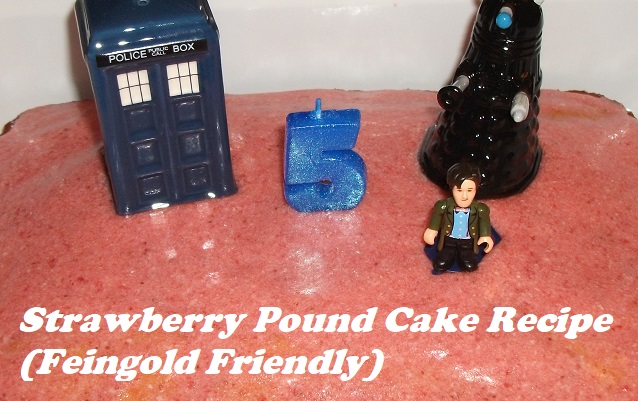
strawberry cake

A few years ago, my son asked me to make a strawberry cake for his birthday.  Unfortunately, every recipe that I could find at the time included strawberry-flavored gelatin mix.  Since I presumed that most of those mixes would include red dye #40, I found another way to give him a strawberry cake which would go along with the diet we follow, called the Feingold Diet.

When my eldest child was diagnosed with ADHD, a specialist that I took her to recommended that I put her on it.  All artificial flavors, colors, and sweeteners are eliminated, along with the chemical preservatives BHA, BHT and TBHQ.  In the first stage of the diet, some natural foods called salicylates are also cut out and slowly reintroduced to test for a reaction.  Since this recipe contains strawberries, which are a salicylate, it would be considered a stage two recipe.

My son loved this cake so much that he requests it for his birthday every year now.  I start with my grandmother’s pound cake recipe, which can be made in two loaf pans or as a 9×13 sheet cake.

Mama Jeane’s Pound Cake:

  • 3 sticks of butter (at room temperature)
  • 3 cups of sugar
  • 5 eggs
  • 3 cups of all-purpose flour
  • ½ teaspoon of baking powder
  • ½ teaspoon of salt
  • 1 cup of buttermilk
  • 1 teaspoon of vanilla

Preheat oven to 325 degrees.  Grease and flour 2 loaf pans or 1 sheet cake pan (I like to use coconut oil for this).  Cream butter and sugar with a mixer.  Add eggs, one at a time, beating well after each addition.  Sift flour with baking powder and salt.  Add to cream mixture; alternate with buttermilk.  Add vanilla.  Bake 1½ hours.  Let cool on a wire rack.

Next, I make a strawberry glaze, which I pour on top of the cake:

Strawberry Glaze:

  • 7 – 8 fresh strawberries
  • 1½ cups of 10x confectioner’s sugar
  • 4 tablespoons of softened butter

Cream butter with one cup of sugar.  Puree strawberries in a food processor.  Add puree to cream mixture.  Gradually mix in remaining sugar.  Drizzle over cooled cake.

Since we don’t eat artificial colors, I usually make a simple butter icing or chocolate icing, so this was a nice change of pace and splash of color.  I added some Doctor Who characters because he loves the show.  The second time I made this, we sliced some fresh strawberries and decorated the cake with them.

I hope you enjoy this recipe as much as we do!

Eliminating Miracles, Conclusion

Miles and Rory

I realize that not everyone’s story ends as mine did.  Some children are born with challenges that my daughter does not have, like my son, who has cerebral palsy.  When I look at him, though, I don’t see a condition.  I see a strong little boy who has overcome obstacles.

One of the special things about having him in our lives is getting to witness miracles.  When he was born, we did not know what his long-term prognosis would be.  There were a lot of things that could have gone wrong.  As it turns out, he has been seizure-free since he was six months old and the only muscle weakness that he has is from the ankle down on one of his legs.  His physical therapist told me that he is the only child with cerebral palsy that she has worked with whose hand on the affected side of the body was not impacted along with his leg.  After what we’ve experienced with him, it seems a little silly that I was afraid to have a child with a different sort of challenge.  What can I say; I am still a work in progress.

Our daughter is a miracle as well.  None of the doctors ever could explain to us why my bloodwork came out the way it did, why my placenta was so unhealthy, why my amnion and chorion fused so late in the pregnancy.  The fact that I had the chorion amnion separation at all is a bit of a mystery, as it doesn’t usually occur spontaneously, but after an invasive procedure, such as an amnio.  A pregnancy is considered at high risk for Down syndrome if the chances are calculated to be 1 in 200.   My results were 1 in 12.  Yet, after all of that, she is completely healthy.

I would never discount the feelings of a parent who has watched their child suffer.  What my own experience has taught me, though, is that there are things that we cannot control, and that is OK.  When I was pregnant with my son, my co-workers teased me about how careful I was about what I put in my body or allowed myself to be exposed to.  In the end, none of it mattered.  The doctor didn’t realize that the cord was wrapped around his neck until it was too late.  That’s not the end of his story, though.  God has a purpose for his life.  He is here for a reason.

Prenatal testing is not perfect.  I am not the first person to be told that my child would likely have a condition that she did not end up having.  I can’t imagine how it must feel to hear one of those stories, if you have aborted your child on the advice of your doctor after a prenatal diagnosis.  I often think of my former co-worker who was pushed into an abortion.  She wanted to wait and hope.  She should have been allowed to do that.

If you give up hope because your doctor thinks there is something wrong with your unborn baby, you might miss hearing the doctor say, “I don’t know what happened, but we were wrong.”  You might miss the moment when a doctor or therapist says, “I didn’t think your child would ever be able to do that.”  Or, you might miss the opportunity to enjoy a radiant smile like I saw on the children at the train station.

You will not have eliminated a potential problem.  You may have just eliminated the chance to experience a miracle firsthand.


Read Eliminating Miracles, Part One.

Eliminating Miracles, Part Three

Rory newborn

Two weeks later, my husband and I went in for another ultrasound.  We’d been praying that the placenta would move up to the proper position as my uterus expanded and also that the amnion and chorion layers of the amniotic sac would fuse as they were supposed to.  However, the perinatologist informed us that neither of those things had happened and he didn’t believe that they would at this point in the pregnancy.  Not only that, but because of where the placenta was located and the limited space in the sac with the separation between the layers, the baby’s growth was very poor.  She was much smaller than she should be and had not made any gains since the last ultrasound.

“When you come for your next ultrasound,” he told us, “be prepared that the baby may have passed away.”

I looked at him and said, “OK.”  He looked as though he thought I didn’t understand him.  It wasn’t that; I just still had that peace in my heart.  I knew that my daughter would be OK.

Three weeks later, we went for the next ultrasound, and the doctor just kept looking very carefully at the screen, not saying a word.  Finally, he told us, “I have good news for you.  The amnion and chorion have finally fused and the baby has grown.”

“I thought you said that wasn’t going to happen,” replied my husband.

“I didn’t think it would.  I can’t explain it,” was the doctor’s response.  He went on to tell us that he didn’t think that our baby had Down syndrome.  He couldn’t guarantee it; but at that point in the pregnancy, there are usually clear signs that he would be able to see on an ultrasound, and they weren’t there.

Very shortly after this, I woke up one morning and discovered that I was bleeding.  I went right in for an emergency ultrasound and the doctor had me admitted to the hospital that day, on bed rest.  My little girl was not due for another 10 weeks.  For about a month, I was in the hospital.  At first, I was allowed to get up to shower or use the bathroom.  However, one morning when I woke up and got out of bed, I suddenly felt a strange sensation, as though the baby was coming out.  I froze and hit the button to call the nurse.  She poked her head in the room to ask what I needed, and upon taking one look at me, turned around and yelled down the hall, “Help!  Help!  She’s bleeding!”

The next thing I knew, a team of people had lifted me back in bed and were hooking up a monitor around my belly.  I heard a thumping noise as my nurse gripped my hand, “That’s your baby’s heartbeat.  She’s OK.”

Then, they told me that I’d passed a very large blood clot.  There was no more getting up for me, for any reason.

They were trying to keep me pregnant for as long as possible, but because I still had a placenta previa, a C-section was necessary and would have to be done before I began having contractions, as there was a danger that the placenta would either rupture and cause me a dangerous amount of blood loss, or it would deliver before the baby, leaving her without any source of oxygen.  They day finally came when they decided that we couldn’t wait any longer.  The baby had stopped growing and was no longer urinating, meaning that the placenta was failing to provide her with nutrition.  An emergency C-section was performed that day.

On July 28, 2011, my fourth child was delivered, six weeks early.  She weighed 3 lbs, 4 oz and was 15” long.  She was tiny, but she was perfect.


Read Eliminating Miracles, Conclusion.

Eliminating Miracles, Part Two

Eliminating Miracles 2 Graphic

My doctor wanted to know if I wanted to have an amniocentesis.  I told him that we did not want any invasive testing because of the risk to the baby and the fact that the results would not change whether I would carry the pregnancy to term.

The doctors decided that I should have ultrasounds every 3 weeks for the remainder of my pregnancy.  The perinatologist who reviewed the results of the ultrasounds was baffled by our unwillingness to have an amnio.  He told me that the risk of miscarriage as a result of the test was very low, but if my child had Down syndrome, she would never go to school, have a job, or live on her own.  She would die at an early age and likely have health complications.  He seemed to use the ultrasounds as a way to look for problems that weren’t there; for instance, telling me that her limbs appeared to be shortened and that the bridge of her nose was too small, which could be signs of DS.  He said that her heart appeared OK, but we might discover a problem with it later, when she was larger and more detail could be seen.  We finally asked our OB/GYN to tell him to stop pressuring us, as we felt our wishes weren’t being respected.

At my 20-week ultrasound, it was discovered that I also had a placenta previa and a rare condition called an amnion chorion separation.  My doctor had told me not to google my conditions, but I did.  That was a mistake.  I found out that most amnion chorion separations accompany a chromosomal abnormality.  I read that the condition also makes an amnio much more dangerous.  I later asked one of my perinatologists about this, and he confirmed that had we done the test, my water would have broken and my baby would have died.

I wish I could say that I was completely trusting God at that point.  I wasn’t.  I had chosen to walk in obedience, but I was afraid of what was going to happen and whether I could handle whatever He was going to give me.  I felt that the amnion chorion separation was confirmation that my baby would have DS.  One day, we took my toddler on an Easter train ride, and while we were at the station that day, I saw two children with Down syndrome – a little blond boy, walking with his parents, and an infant girl, being held by her mother aboard the train.  They were beautiful.  Their smiles radiated joy.  I realized how ridiculous it was to fear that my child might be like them.  These children were gifts from God.

Not long after that, I went on a women’s retreat with my church.  While I was there, able to have some quiet time away from my day-to-day responsibilities, I felt God clearly speaking to my heart.  He gave me this verse:  “Thus says the Lord to you: ‘Do not be afraid nor dismayed because of this great multitude, for the battle is not yours, but God’s.” – 2 Chronicles 20:15.  I felt peace for the first time during my pregnancy.  I knew that He was telling me that He would take care of my baby, but that there was nothing that I could do but trust Him and leave her in His loving hands.  The timing of that moment was perfect, but it wasn’t long before that peace in my heart would be tested.


Read Eliminating Miracles, Part Three.