Developing Patience for the Road Ahead

Developing Patience for the Road Ahead

Back in May, I wrote this post for the Homeschooling with Heart blog.   I almost didn’t get it written, because a tornado hit our state, and we lost power for almost a week.

The first two days, my children kept asking when they’d be able to watch TV or use the computer again.  I’ve made a point to limit their screen time, and because there was less availability and dependence on these things when I was raising my two adult children, having a device always on hand to entertain them just didn’t seem natural to me.  Even so, my kids still went through a withdrawal of the screen time that they are allowed to have.

They began to wander outside frequently to entertain themselves and joined with some neighborhood children to build a shelter in the woods behind our house.  I ended up having to coax them indoors for meals.  They managed to find something to engage them that also created an opportunity for teamwork and socialization.  It was almost a blessing in disguise.

Meanwhile, I was going through the withdrawal of having running water and access to information about what was going on, without phone or internet service.  I attempted to model patience for my children, along with gratitude that our home was not damaged in the storm and none of us was injured, although it became more difficult to do as the week wore on.

My reflection on this experience is that you never know when a situation like this will happen.  Many things are out of our control, and it is easier for you and your children to deal with when the virtue of patience has been developed.  It is these moments when it is really put to the test that you begin to realize just what an important life skill it is and how much you are actually lacking it versus what you would normally give yourself credit for.

In my opinion, the real long-term benefit of learning to wait until later for what you want now is the ability to wait on God.  It took many years of waiting and praying before I met my husband.  It might be a spouse, a job, the birth of a child, or any number of things that you or your child needs to wait on God for.

One thing that I have found helpful for my own children is making it the default that they wait in public (at a sibling’s extracurricular activity; at the DMV) without devices to entertain them.  If they’ve had practice stretching and developing those muscles during these short periods of waiting, I believe it will help them to be better prepared for the marathon when it inevitably comes.

My goals for the future are to be a better example of patient waiting in times of stress, to pray that God strengthens both my patience and that of my children, and to trust that He can do this work in us.


“A man can receive nothing unless it has been given to him by heaven.” – John 4:27

“But the ones that fell on the good ground are those who, having heard the word with a noble and good heart, keep it and bear fruit with patience.” – Luke 8:15

The Importance of Outdoor Education in a Digital World

29387084_10215590266971378_5206724819273383936_n

I grew up in a large city.  Swapping childhood stories with my husband, he was appalled when I explained that recess at the schools that I attended meant being released to an enclosed, asphalt yard.  I counted myself lucky that I actually had a backyard at home with trees and flowers.  Most of my friends only had a small square of grass in front of their house.  Needless to say, our exposure to nature was a bit limited.

Luckily, the private school that I went to recognized this need.  We had an environmental education program in grades 4 through 6, where we got to stay at a campground for a few days in the fall and the spring.  I recently asked some old schoolmates about it, and found that they have as many treasured memories of the experience as I do.

Unlike me, my children are growing up in a more rural area.  They have much more experience with nature than I did.  Even so, when we went camping for our family vacation this year, and completely disconnected from electronics (no TV, cell phones, or other devices), my children were even more engaged with the world around them than normal.  Some of the things that we did were:

  • Identified leaves and plants that we found
  • Learned about wildlife that was native to the area
    • Learned the differences between venomous and non-venomous snakes
    • Learned how to identify raptors in flight
  • Collected leaves, ferns, etc. and made charcoal rubbings and sketches in nature journals
  • Observed and felt moss growing
  • Found a bird’s nest
  • Saw the natural growth and decay of the forest
  • Learned how to build a fire and cook over it
  • Practiced carving wood
  • Collected pine resin and learned some uses for it

29433086_10215590268331412_4058184408941723648_n

My son actually remarked that he thought life was better without TV!  Being outside without the distractions of modern society allows for more intimacy with nature and with each other.  We interact more fully with each other.  It inspires awe.  It demands use of all of the senses and strengthens observation skills.  Navigating on uneven terrain helps to develop core strength and a sense of balance.  Self-directed learning occurs naturally in the outdoors, as children ask questions about the world around them.

In my son’s case, I’ve watched his confidence grow as he is now able to answer some of his younger sister’s questions.  Sometimes, he can even answer mine, when he shares a tidbit that he has learned from his father.

Of course, we can’t camp all the time, but now that it is spring, we often finish up our school day with a walk.  I ask them to point out any signs of spring that they notice and it is fun to witness the progression from day to day.  The exercise, fresh air, and connection with nature is calming and has pretty much the opposite effect on them that screen time does.  Screens have their place in our lives, but they cannot replace time spent outdoors, which meets a need that seems to be instilled in us from our Creator, to recognize our part in His creation.


“But now ask the beasts, and they will teach you;

And the birds of the air, and they will tell you;

Or speak to the earth, and it will teach you;

And the fish of the sea will explain to you.

Who among all these does not know

That the hand of the Lord has done this,

In whose hand is the life of every living thing,

And the breath of all mankind?”  – Job 12:7-10


Trusting God’s Plans for My Children

candle-light_2

This is my daughter’s third year studying classical ballet, and she loves it.  After her first year, her teacher decided to keep her in level one.  I agreed that if she hadn’t mastered the basics, it made sense for her to remain there until she was ready to move on.  After all, as a homeschool parent, I understand how important mastery is in any subject.

At the end of her second year, her teacher decided to hold her back again.  Most of her friends had moved on without her after the first year, and now, this year’s classmates would do the same, including her best friend.  I was afraid that watching her peers move ahead without her would damage her self-esteem and wondered if she should try a different activity.  Maybe she would be more successful at something else.

My husband was the voice of reason.  He said, “She loves dance.  As long as she wants to do it, who cares what level she’s at?”

So, she began her third year in level one, while taking some private lessons in addition to help her catch up.  She also wanted to try scouting, like her brother, but I had a lot of trouble finding a local troop for her.  Her best friend’s mom told me about a group that her daughter was attending that was similar to scouts, but Bible-focused instead, so we decided to try that.  However, it turned out that the time of her friend’s level two dance class conflicted with the other activity, so she couldn’t participate this year.  I briefly wondered if we should forget about it, but decided to let my daughter try it out, anyway.

She absolutely loved the new club and was very motivated to bring her book home to read the lessons with me and practice memorizing Bible verses.  Before I knew it, she was earning rewards almost every week and feeling proud of her accomplishments.  She also enjoys the time each week with her new friends.

This past week, I overheard her dance teacher compliment her during class and the thought crossed my mind that maybe she was getting ready to move up, which could happen at any time during the year.  I was initially pleased, until it occurred to me that attending the level two classes would prevent her from going to her other club.  I know that would disappoint her.

This made me reflect on how God has assigned each of us individual gifts and has a plan for us to use them.  While I was concerned about her lack of success in one area, He knew that he had another place for her, one in which she not only would excel but would do so while being immersed in His Word and learning to write the words of it on her heart.

As we enter a new year, I want to learn to trust His plans for my children more and worry less.  I know that I am leaving them in the best possible hands.


Wineberries and Trust

IMG_20170624_125346

My little one, picking black raspberries in our yard.

A few years ago, I began picking berries to make jam.  My children have some food sensitivities, particularly to artificial ingredients.  We had some raspberries growing in our yard, and on a walk around the block, discovered an undeveloped property brimming with wineberries, a variety of wild raspberry.  My mission seemed clear – learn how to make homemade jam for my peanut butter and jelly-loving but ingredient-sensitive children.

The funny thing is, when we moved in to our home a decade ago, my husband discovered that one of our flower gardens was full of thorny red raspberry bushes.  He asked me whether I wanted to use the berries or whether he could tear them out and plant flowers instead.  I said that I wasn’t partial to raspberries, so do whatever you like.  I never dreamed that six years later, I would be braving thorns and poison ivy at the park and the property around the corner to collect as many raspberries as I could each summer.  I had a few stragglers left in my garden, but not enough to produce a jar of jam.

A couple of years into this, a friend pointed out that the berries in the park could have pesticides sprayed near them, which made them less appealing to me.  I still had some red raspberries in my garden, which were beginning to spread, and I discovered some black raspberries and blackberries in an overgrown area of my yard that my husband had partially cleared.  For wineberries, I still had my spot around the corner.  One day, though, as we took a walk, we discovered that the lot had been sold and was being cleared, so a house could be built there.  Our berry bushes were being dug up!  I suggested to my husband that we transplant one to our yard, which we did – a small one.  Eventually, that bush finally produced fruit and this year it has grown quite a bit, although it would never provide as much as we had been collecting from its original home.

Two summers ago, however, as I was collecting black raspberries on the outskirts of my property, I noticed a distinctive, fuzzy fruit developing nearby.  It was a wineberry bush!  It was not the one planted by me, nor close to it.  It was a new plant that had never been there before.  We speculated that a bird had spread the seeds there after eating some berries from our bush.  This particular bush now dwarfs the one that we planted, by far.  It is well on its way to replacing the place around the corner.  It produced so much fruit this past summer that I could barely keep up with picking it.

It amuses me to think about the time that I wasted worrying about my supply being cut off and tried to rectify it in my own way with my transplant, when God knew all along that He was going to bless me with this plant one day.  In my experience, that’s how it usually is when we rely on our own strength, instead of depending on God.  Our efforts will always be imperfect and pale in comparison to His perfect will and timing.

More importantly, that time spent waiting on Him to provide is usually the most productive in our own spiritual growth.  Learning to trust Him in a way that we never could with an earthly father (or any other human being, for that matter) stretches us in unimaginable ways.  When we stop striving to be our own God, making an idol of our own self-sufficiency, we can finally experience the peace that passes understanding.  We can focus on hearing His voice and being open to direction, which was once crowded out by our worries. .

“Blessed is the man who trusts in the LORD and whose hope is in the LORD.  For he shall be like a tree planted by the waters, which spreads out its roots by the river, and will not fear when heat comes; but its leaf will be green, and will not be anxious in the year of drought, nor will cease from yielding fruit.” – Jeremiah 17:7-8

Why I Created a Blog

Spring forest in the Netherlands

For several years, people suggested off and on to me that I start a blog because they knew that I enjoyed writing.  I considered it, but I felt the same way about that as I did about acting when I was a teenager.  It’s great fun to be onstage when you are portraying a character, but if I was called on in class to speak my mind aloud, I was very uncomfortable.  I can write press releases and informational text all day long, but revealing myself to the world is another thing altogether.

So, about a year and half ago, when I felt God putting it on my heart to create a blog, I resisted at first.  He’d given me inspiration for an opening post and I composed it, but kept finding excuses not to take the next step.  I needed to finish our homeschool year first.  I had to plan my daughter’s wedding next.  In the meantime, my mind was flooded with things that I needed to say (and would periodically stop to put on paper).

Eventually, summer arrived and the wedding was over.  I opened up my local paper, which I rarely do, and spied a letter to the editor.  A councilman from the town that my church is located in had written it, making arguments as to why we should not be allowed to build our permanent church (rather than renting space, as we do now) on the land that we have recently been given.  Although he was attempting to veil it, I saw his prejudice of churches between the lines and that he had a false impression of what the Body of Christ really is.  I felt God calling me to respond to it.  Initially, I thought, “I’m not even a resident of that town.  What difference does my opinion make?”

That Sunday, however, as we read about the parable of the talents, I felt convicted.  When I was in middle school, my English teacher, Mrs. Kruvcyk, told me that writing was the gift that God had given me and I needed to use it.  When I ran into her years later and she asked me what I did for a living, I saw her disappointment when I told her that I was an administrative assistant.  Was I burying my talent in the sand instead of investing it in the Kingdom, as God would have me do?

I made up my mind to be obedient in this small thing that God had asked me to do.  I wrote a rebuttal letter and sent it off, careful to edit my flesh out and stick to what I thought that God wanted me to say.  That Saturday, my letter appeared in the paper and a couple of days later, one of the assistant pastors called me.  “I thought you’d like to know that we had two separate people visit our church on Sunday who said they came because they read your letter in the paper,” he told me.

I was flabbergasted.  Although I know that as a believer, I am called to spread the Gospel to unbelievers, I have always felt unqualified to do that.  I am introverted and socially awkward.  No one would ever visit church or get saved because of my influence.  Well . . . aside from my husband, that is.

The lightbulb went off then that it doesn’t matter what flaws or failings that I have.  All I really need to do is be obedient to what the LORD has called me to do and use the gifts that He has given me to His glory.  He’ll take care of the result.

That’s when I knew that it was time for me to take a step of faith and just create a blog already.  I’ve known since I was eleven years old what my primary gift is.  If God was asking me to use it, then I needed to stop hesitating and just do it, because He obviously has a plan to use it for His purposes.


Relationship, Obedience & Homeschooling

Relationship obedience pic for blog

Recently, as we were waiting for our daughters at dance class, another mom asked if my children had started school yet.  I explained that we had begun our school year, but we homeschool.  In response, she said, “I thought about homeschooling, but in the end, I decided that my relationship with my children would be better if I weren’t their teacher, too.”

A few years ago, a friend of mine who was considering homeschooling her child shared with me her worry that her son wouldn’t listen to her if she tried to teach him, and therefore, not get his school work done.

I cannot judge either one of these concerns.  I understand them well, because I’ve had them myself.  As I’ve prayed through them, though, God has shown me His heart about these things.

Relationships require interaction and time spent together to grow in intimacy, not time apart.  The reason that “absence makes the heart grow fonder” isn’t because you love someone more when you are apart; it is because the less you are together, the less opportunity there is for conflict to develop.  God’s Word shows us that He is very relational.  He is our Abba Father.  Jesus is His son.  The church is called His bride.  How can we model for our children an intimate relationship with God unless we have one with them?

Also, it is very important that we all learn obedience to God.  How do we prepare our children for that responsibility if we haven’t taught them to obey us first?  Personally, I’ve been very frustrated by a stubborn disobedience that has arisen in my 6-year-old lately.  I warn her that there will be consequences if she doesn’t make the right choice in a given situation.  Yet, she continues to push the limits until I end up having to take a privilege away.  Then, the tears flow, as though she didn’t already know that was going to happen.

I don’t want to chasten my children or remove blessings from them.  However, this helps me to realize how God feels about me.  He wants my obedience and for me to listen to His leading, so he can bless me also.  That just confirms to me that I need to stick with it.  My daughter will find it much easier to follow God in the long run if she gets her heart right in this area now.  It also helps me to keep my eyes on Him in my own walk.  If it hurts me this much to punish my child, I can imagine how much more my Father in heaven is grieved by me at times.

If I weren’t home with my children all day, I’d have a lot less time to help them build their characters and encourage their spiritual growth, but it would still be my responsibility, even if someone else was teaching them to read and write.  So, I embrace the challenge, trusting that God will work in their hearts to bring them closer to Him.

“Then I will give them a heart to know Me, that I am the Lord; and they shall be My people, and I will be their God.” – Jeremiah 24:7

 Note:  This post was written for The Old Schoolhouse® Magazine’s Homeschooling with Heart Blog and the intended audience is parents who feel that they have been called to homeschool.

The Specks in History

The Specks in History Graphic 1

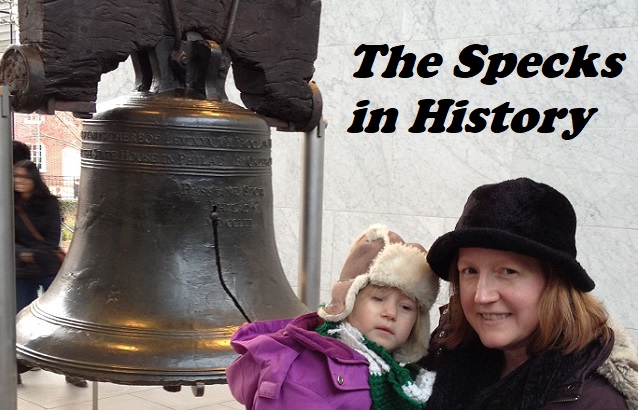
A couple of years ago, my husband and I took our children on a field trip to see the Liberty Bell in Philadelphia.  When we exited the building, there was a television monitor outside loudly playing a video disparaging one of the founding fathers.  We hurried the children away from it.  It just felt wrong to me.

With the recent stories in the news about statues being torn down by angry mobs, I’ve given this some more thought.  As a homeschooling parent, it begs the question, “What is the right approach in teaching my children about historical figures?”

I suspect that the reason that there is so much vitriol towards some of these people is because the tendency in the past has been to venerate them and hold them up as examples to our children.  I can understand why that would have happened.  How better to inspire children to use their God-given gifts to the utmost and not settle for mediocrity than to give them an accomplished person to emulate?  The pushback to that in recent generations seems to be to point out their every moral failing, as if to make them pay penance for their fame.

As a Christian, I believe my job is to teach my children to idolize and imitate only one human being – Jesus Christ.  Anyone else, successful or not, is only another sinner just like them.  Even public figures that are generally admired by most of us still have hidden sins, as do we.  No one has attained perfection.

I want to teach my children both by my words and my example to emulate Jesus.  In order to do this, I have to follow His commands.  That includes not attempting to remove the speck from someone else’s eye when I have a plank sticking out of my own eye (Matt. 7:1-5).  It also means that I should not cast the first stone, when I am not without sin myself, and that I should treat others the same way that I want to be treated (John 8:7; Matt.7:12).

I also think that it’s a good idea to provide balance in our history lessons; presenting both what someone may have done that was right versus mistakes that they made.  There has to be a line, though, where I determine what information is useful for them to have and what is just tabloid fodder.  One thing that I find helpful is to take off my 21st century lens for a moment and look through the lens of the time period we are studying.  Every generation has their predominant sins.  There are things that were accepted in the past that appall us, but if the people living in that time were able to look forward to practices that are generally accepted today, they’d find plenty to be appalled with as well.

After I’ve removed and carefully examined the plank that was in my own eye, it makes me a lot more humble and less likely to harshly point out the speck in another’s eye.  If the person is deceased, what can be accomplished by pointing out their failings at all?  In the end, I wouldn’t want my own sins blaring from a TV into the streets of Philadelphia, so I won’t do that to someone else.

“Judge not, that you be not judged.  For with what judgment you judge, you will be judged; and with the measure you use, it will be measured back to you.  And why do you look at the speck in your brother’s eye, but do not consider the plank in your own eye?  Or how can you say to your brother, ‘Let me remove the speck from your eye’; and look, a plank is in your own eye?  Hypocrite!  First remove the plank from your own eye, and then you will see clearly to remove the speck from your brother’s eye.” – Matthew 7:1-5

The Baptism and Racism

ki85B6ybT

Last Sunday, we held an indoor immersion baptism at my church.  A large, metal trough was brought into the church and filled with water.  To be honest, I thought it was a little weird when I heard of that plan.  The experience far exceeded my expectations, though.  There was a brief sermon, and for the rest of the service, the worship team played while people lined up to be baptized.

Now, I’ve been to plenty of baptisms in my day – infant christenings where they sprinkle a little water on the baby’s head; lake, pond and even swimming pool immersions.  My pastor baptized me in a swimming pool at his parents’ house.  This was something altogether different.  It was as though there was electricity in the air last weekend.  You could just feel the Holy Spirit moving in a powerful way.  I was singing really loud, dancing in my seat, and I briefly thought about how, as a new believer, I would have wanted to let my hair down that way, but would have been afraid to.  Before I got saved, I would have been intimidated by that whole scene – people standing with their hands raised, etc.  Deep down, I would have known it was authentic, though.  It was that sort of feeling that hooked me when my Nana convinced me to visit her church one Easter, sixteen years ago.  The joy that I felt in that service was like nothing I’d experienced in my church upbringing.  This service blew that one out of the water, though.  I was giddy afterwards, and so was everyone else that I talked to.

For me, one of the beautiful things about it was seeing people of different races lined up together to get in the water.  I live in a very monochromatic area, so it is no surprise that our church has typically reflected that.  Having grown up in the city, that is not normal to me, though.  Our church has experienced a lot of growth over the past few years, and I believe it is a blessing that we are beginning to look more like a melting pot now.

After returning home that day and having some lunch, I made the mistake of getting on social media.  A friend from my youth, who has been actively posting a lot of political stuff lately, shared a clickbait article about some racist white woman with the commentary “I’m beginning to think they are all like this.”  Well, so much for feeling giddy.  It was bad enough that he was stereotyping me unfairly, but to make matters worse, this man is married to a white woman and his only child is half white.

I was tempted to respond, but I don’t believe you can talk someone out of prejudice.  Some people open their eyes eventually, but you can’t pry them open for them.  The conclusion that I came to is this.  What I witnessed in my church is what happens when we let Jesus have control.  He brings truth, love, unity, joy and peace.  People loving one another and rejoicing over their new brothers and sisters – that is what Jesus does.

Satan brings deceit, fear and hate.  When media outlets write and publish divisive articles that sacrifice unity on the altar of the god of mammon, it’s obvious who they are giving control to.  It’s sad that there are people who allow their view of the world to be shaped by that.

Personally, I’ll take Jesus.  The view from here is a lot sweeter.


“There is one body and one Spirit, just as you were called in one hope of your calling; one Lord, one faith, one baptism; one God and Father of all, who is above all, and through all, and in you all.” – Ephesians 4:4-6                                                                    

Eliminating Miracles, Conclusion

Miles and Rory

I realize that not everyone’s story ends as mine did.  Some children are born with challenges that my daughter does not have, like my son, who has cerebral palsy.  When I look at him, though, I don’t see a condition.  I see a strong little boy who has overcome obstacles.

One of the special things about having him in our lives is getting to witness miracles.  When he was born, we did not know what his long-term prognosis would be.  There were a lot of things that could have gone wrong.  As it turns out, he has been seizure-free since he was six months old and the only muscle weakness that he has is from the ankle down on one of his legs.  His physical therapist told me that he is the only child with cerebral palsy that she has worked with whose hand on the affected side of the body was not impacted along with his leg.  After what we’ve experienced with him, it seems a little silly that I was afraid to have a child with a different sort of challenge.  What can I say; I am still a work in progress.

Our daughter is a miracle as well.  None of the doctors ever could explain to us why my bloodwork came out the way it did, why my placenta was so unhealthy, why my amnion and chorion fused so late in the pregnancy.  The fact that I had the chorion amnion separation at all is a bit of a mystery, as it doesn’t usually occur spontaneously, but after an invasive procedure, such as an amnio.  A pregnancy is considered at high risk for Down syndrome if the chances are calculated to be 1 in 200.   My results were 1 in 12.  Yet, after all of that, she is completely healthy.

I would never discount the feelings of a parent who has watched their child suffer.  What my own experience has taught me, though, is that there are things that we cannot control, and that is OK.  When I was pregnant with my son, my co-workers teased me about how careful I was about what I put in my body or allowed myself to be exposed to.  In the end, none of it mattered.  The doctor didn’t realize that the cord was wrapped around his neck until it was too late.  That’s not the end of his story, though.  God has a purpose for his life.  He is here for a reason.

Prenatal testing is not perfect.  I am not the first person to be told that my child would likely have a condition that she did not end up having.  I can’t imagine how it must feel to hear one of those stories, if you have aborted your child on the advice of your doctor after a prenatal diagnosis.  I often think of my former co-worker who was pushed into an abortion.  She wanted to wait and hope.  She should have been allowed to do that.

If you give up hope because your doctor thinks there is something wrong with your unborn baby, you might miss hearing the doctor say, “I don’t know what happened, but we were wrong.”  You might miss the moment when a doctor or therapist says, “I didn’t think your child would ever be able to do that.”  Or, you might miss the opportunity to enjoy a radiant smile like I saw on the children at the train station.

You will not have eliminated a potential problem.  You may have just eliminated the chance to experience a miracle firsthand.


Read Eliminating Miracles, Part One.

Eliminating Miracles, Part Three

Rory newborn

Two weeks later, my husband and I went in for another ultrasound.  We’d been praying that the placenta would move up to the proper position as my uterus expanded and also that the amnion and chorion layers of the amniotic sac would fuse as they were supposed to.  However, the perinatologist informed us that neither of those things had happened and he didn’t believe that they would at this point in the pregnancy.  Not only that, but because of where the placenta was located and the limited space in the sac with the separation between the layers, the baby’s growth was very poor.  She was much smaller than she should be and had not made any gains since the last ultrasound.

“When you come for your next ultrasound,” he told us, “be prepared that the baby may have passed away.”

I looked at him and said, “OK.”  He looked as though he thought I didn’t understand him.  It wasn’t that; I just still had that peace in my heart.  I knew that my daughter would be OK.

Three weeks later, we went for the next ultrasound, and the doctor just kept looking very carefully at the screen, not saying a word.  Finally, he told us, “I have good news for you.  The amnion and chorion have finally fused and the baby has grown.”

“I thought you said that wasn’t going to happen,” replied my husband.

“I didn’t think it would.  I can’t explain it,” was the doctor’s response.  He went on to tell us that he didn’t think that our baby had Down syndrome.  He couldn’t guarantee it; but at that point in the pregnancy, there are usually clear signs that he would be able to see on an ultrasound, and they weren’t there.

Very shortly after this, I woke up one morning and discovered that I was bleeding.  I went right in for an emergency ultrasound and the doctor had me admitted to the hospital that day, on bed rest.  My little girl was not due for another 10 weeks.  For about a month, I was in the hospital.  At first, I was allowed to get up to shower or use the bathroom.  However, one morning when I woke up and got out of bed, I suddenly felt a strange sensation, as though the baby was coming out.  I froze and hit the button to call the nurse.  She poked her head in the room to ask what I needed, and upon taking one look at me, turned around and yelled down the hall, “Help!  Help!  She’s bleeding!”

The next thing I knew, a team of people had lifted me back in bed and were hooking up a monitor around my belly.  I heard a thumping noise as my nurse gripped my hand, “That’s your baby’s heartbeat.  She’s OK.”

Then, they told me that I’d passed a very large blood clot.  There was no more getting up for me, for any reason.

They were trying to keep me pregnant for as long as possible, but because I still had a placenta previa, a C-section was necessary and would have to be done before I began having contractions, as there was a danger that the placenta would either rupture and cause me a dangerous amount of blood loss, or it would deliver before the baby, leaving her without any source of oxygen.  They day finally came when they decided that we couldn’t wait any longer.  The baby had stopped growing and was no longer urinating, meaning that the placenta was failing to provide her with nutrition.  An emergency C-section was performed that day.

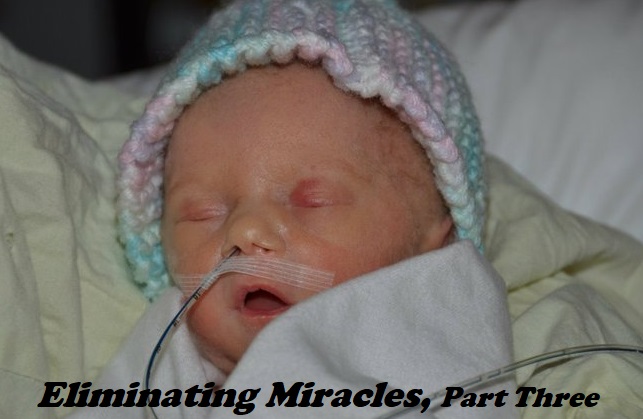
On July 28, 2011, my fourth child was delivered, six weeks early.  She weighed 3 lbs, 4 oz and was 15” long.  She was tiny, but she was perfect.


Read Eliminating Miracles, Conclusion.